
Does Llano County require a building permit for a barndominium?
Llano County issues no building permits and runs no building department, no building code and no building inspector. Its development pages and its permit portal list development, septic, RV park, manufactured home, plat and road cut applications and nothing else, and the words building permit appear nowhere in the county’s own on-site sewage order, subdivision regulations or flood damage prevention order. What a new house does need is a county development permit, which is also how the property gets its 911 address, a septic permit, and a floodplain development permit where any of the lot is in a mapped special flood hazard area. The county asks for seven to 10 business days on a review outside the floodplain, and longer for floodplain work, septic and commercial projects.
Source: Llano County Development Services, read 2026-09-13.
Inside city limits, the city's own building department applies whatever the county does, and a city's extraterritorial jurisdiction can add platting and environmental rules outside its limits. The first question about any lot is which of the three it is in.
Who do I call in Llano County to confirm?
Llano County Development Services, 325-247-2039, 100 W Sandstone Street, Suite 200A, Llano. Ask whether the county requires a permit for a new single-family home outside city limits and whether it inspects. That call takes five minutes.
Other county permits the official site shows:
- Development permit, which is also the 911 address application
- On-site sewage facility (septic) permit
- Floodplain development permit in a special flood hazard area
- Road cut permit and the precinct commissioner’s written permission for anything in the county right of way
- Plat, where land outside city limits is divided into two or more parts
Does the septic permit come from the county or from the river authority?
Llano County has three state-authorized septic agents: the county, covering the unincorporated county plus the part of Horseshoe Bay outside the river authority's jurisdiction, the Lower Colorado River Authority, and the City of Horseshoe Bay. TCEQ designated LCRA as an authorized agent to administer the state's on-site sewage rules inside its jurisdiction, and LCRA shows up that way in only three of the six counties this site covers, Travis, Burnet and Llano. It does not appear in Williamson, Bastrop or Caldwell. Which office you deal with follows the address.
The jurisdiction is drawn as a zone, not a shoreline. LCRA regulates on-site sewage facilities within 2,200 feet of the upper Highland Lakes, and the regulated area is built from two layers: a Restricted Zone at each lake, plus a Water Quality Zone extending 2,000 feet horizontally beyond the outer boundary of that Restricted Zone. Buchanan, Inks and LBJ are named in those rules and all three are in this county. LCRA publishes an address-searchable OSSF and watershed jurisdiction map, so the first move on any lot is to look the address up rather than judge it by how far the water looks. Acreage does not change the answer on either side of the line: inside LCRA's jurisdiction a permit is required before any system is built regardless of lot size, and the county permits every system whatever the tract size. The state rule that exempts a single-family system on ten acres or more, with all parts at least 100 feet from the property line and effluent disposed on the property, is set aside here, because a local authorized agent may adopt stricter standards and those stricter standards control.
There is a second water approval that can land on a lot in this county. The Highland Lakes Watershed Ordinance covers a portion of Llano County above the Regulated Pool Elevation of the Highland Lakes, as drawn on the official Ordinance Map, and it regulates construction of buildings, roads, paved storage areas and parking lots plus any land-disturbing activity including clearing, excavating, grading, contouring, mining and depositing refuse, waste or fill. A development permit is required if impervious cover will exceed 10,000 square feet and/or land disturbance will exceed one acre. A single-family residence under both of those can go the written notification route instead of a permit, and if it exceeds the impervious cover figure but still disturbs under one acre it can still use written notification only where the site meets the downstream buffer guidelines in LCRA's Technical Manual. Eleven local governments administer part or all of the ordinance under interlocal agreements, so an LCRA permit may not be the one that applies to your tract.
Timing: allow up to 30 days from the date of submission for a new LCRA system permit, not counting design or site complications. Separately, an OSSF permitting authority must approve or deny planning materials and the application within 30 days of receipt, with a written explanation on denial and an appeal to its supervisory body.
If rock or slope pushes the design to an aerobic treatment unit, a maintenance contract is required for the first two years. After two years the owner may do the maintenance, but only after taking the class and passing the test.
Buying a lot that already has a system: an inspection is required on every transfer of ownership before LCRA will approve the new owner for continued use.
Only a licensed or TCEQ-registered installer may build the system. Installer I covers standard systems, Installer II covers all types, and TCEQ's public license lookup for OSSF professionals confirms a person before you hire. TCEQ's authorized agent lookup is a county search that returns every agent in the county and the area each one serves.
Emergency repairs need no permit but must be reported to the permitting authority in writing within 72 hours after repairs begin.
The mechanics of the application, the planning materials and the soil work are the same in every county on this site, and they are covered in the septic permit guide for a Central Texas barndominium.
Source: TCEQ OARS county search, Llano County (CNTY_CD 150), read 2026-09-13.
Source: TCEQ OARS county search, identical entry returned for Travis, Burnet and Llano counties, read 2026-09-13.
Source: LCRA On-Site Sewage Facilities Program, read 2026-09-13.
Source: LCRA On-Site Sewage Facilities Rules, Section 6, Area of Jurisdiction, read 2026-09-13.
Source: LCRA On-Site Sewage Facilities Rules, Section 10.05(b), read 2026-09-13.
Source: LCRA Water Quality Jurisdictions map, read 2026-09-13.
Source: LCRA On-site Sewage Rules Frequently Asked Questions, read 2026-09-13.
Source: TCEQ, Getting a Permit for an On-Site Sewage Facility, read 2026-09-13.
Source: TCEQ adopted rule text, 30 TAC Chapter 285, Rule Project No. 2021-030-285-CE, section 285.3, read 2026-09-13.
Source: Texas Health and Safety Code Sec. 366.032(b), read 2026-09-13.
Source: TCEQ, Occupational Licenses: On-Site Sewage Facilities (Septic Systems), read 2026-09-13.
Source: TCEQ, On-site Sewage Facilities: Information for Regulators, read 2026-09-13.
Source: TCEQ On-Site Activity Reporting System, search by county, read 2026-09-13.
Source: LCRA Highland Lakes Watershed Ordinance, Section 1, Title and Scope, read 2026-09-13.
Source: LCRA Highland Lakes Watershed Ordinance program page, read 2026-09-13.
Source: LCRA Highland Lakes Watershed Ordinance program page, Required notifications and permits, read 2026-09-13.
Source: LCRA Highland Lakes Watershed Ordinance, Section 4.1(b), Written Notification, read 2026-09-13.
Source: LCRA Highland Lakes Watershed Ordinance program page, Interlocal agreements, read 2026-09-13.
Source: Llano County Development Services, read 2026-09-13.
What is under the lot, and what does that do to the well and the dig?
Two minor aquifers sit under the uplift country. The Ellenburger-San Saba Aquifer covers parts of 16 counties in the Llano Uplift area of central Texas. The Hickory Aquifer is made of the water-bearing parts of the Hickory Sandstone Member, and the state's description of it records radionuclides derived from the Precambrian granite of the Llano Uplift. That is a water-testing and treatment question, and it is a question about your specific well, not a verdict on any lot.
No permit in this county asks about your well water, which is exactly why the question gets skipped. Before you budget a well, ask the driller which formation it will be completed in, ask what nearby wells in that formation test at, and ask what treatment is normal for the answer you get. Get the treatment allowance into the build number early rather than discovering it after the slab is poured.
The rock that holds the water also complicates the hole. A bid that says nothing about what happens when the machine hits granite is a bid with a blank in it. Ask whether rock excavation is included, excluded, or carried as an allowance, and ask the same about the post holes if pipe fence and an entrance gate are in the plan, and about the culvert trench if the drive crosses a low spot. Ranch roads, culverts and low water crossings covers that side of the site work.
The building is the quotable half and the ground is not. A per-square-foot number covers the structure and stops there: septic, driveway, power, water, rock and the pad are priced on the site itself. what a barndominium costs in central texas carries the one figure this site will publish, with the date and whose number it is.
If a stock tank or pond is part of the plan, that is land-disturbing work and belongs in the same conversation as the watershed ordinance thresholds above. Stock tanks and ponds covers what that involves.
Compare notes with Burnet County next door, where the same uplift rock juts up through the limestone at the east edge, and with Travis County down the chain, the third county where the river authority is also a septic agent.
Source: Texas Water Development Board, read 2026-09-13.
Source: Texas Water Development Board, read 2026-09-13.
Source: Texas Water Development Board, Report 360 Chapter 9, Paleozoic Aquifers of the Llano Uplift, read 2026-09-13.
Source: Texas Water Development Board, Report 360 Chapter 9, read 2026-09-13.
Source: Texas Parks and Wildlife Department, Enchanted Rock State Natural Area, read 2026-09-13.
Source: Texas Parks and Wildlife Department, read 2026-09-13.
Source: TCEQ OARS county search, identical entry returned for Travis, Burnet and Llano counties, read 2026-09-13.
Source: Llano County Development Services, read 2026-09-13.
What changes if the lot is inside the city of Llano or inside Horseshoe Bay?
Inside the city of Llano the picture inverts. The city's Code Enforcement Department issues building, plumbing, electrical and mechanical permits and inspects all permitted work, and the city has adopted the 2021 International Residential Code along with the 2021 IBC, IPC, IMC, IFGC, IECC, IEBC and the 2021 National Electric Code. A build that would see no code review a few miles out gets a full permit and inspection cycle on a city lot. That is not a downside for a barndominium, it is a documented set of inspections you did not have to buy by contract. It does mean the schedule and the plan set have to be built for it from the start. The Llano town page covers the city side.
Horseshoe Bay is the other city case and the unusual one. It runs its own septic program as one of the county's three authorized agents. What it requires for the building itself is not something this page can state, so ask Horseshoe Bay's own office directly for its permit list, its adopted code and its inspection schedule. Do not assume either the county picture or the Llano city picture carries over.
The mailing town is not the jurisdiction. Check the address itself before you assume the county answer applies to your lot.
Ask any city office three things in one call: which permits it issues, which code edition it has adopted, and whether any of that reaches outside the city limits.
Whether you need a building permit across the six counties lays the city and county answers side by side.
Source: City of Llano Code Enforcement Department, read 2026-09-13.
Source: TCEQ OARS county search, Llano County (CNTY_CD 150), read 2026-09-13.
Source: Llano County Development Services, read 2026-09-13.
With no state builder license and no county code review, what can you actually verify?
Start with what does not exist. Texas does not require a state license to work as a general contractor, although local city or county requirements may still apply, and the Texas Residential Construction Commission was abolished when its enabling Act expired on September 1, 2009. So independent builder is the accurate description of everyone you will talk to in this county, and there is no state license to check on the builder. Licensed attaches to the trades: plumbers are licensed by the Texas State Board of Plumbing Examiners, electricians are licensed by TDLR and non-exempt electrical work must be done through a licensed electrical contractor, and septic installers are licensed or registered by TCEQ. Those three you can verify, and you should.
The Local Government Code does give counties a route to residential building code standards, but it is opt-in, not automatic: it applies only to a county that has first adopted a resolution or order opting in and that is either within 50 miles of an international border or above the stated population threshold. Where a county has opted in, new residential construction in the unincorporated area must meet the International Residential Code as published May 1, 2008, or the IRC version in force in that county seat, and at least three inspections are required, foundation before concrete, framing and mechanical before drywall, and on completion. Even there the builder, not the county, contracts those inspections, from one of six listed qualified persons, and the subchapter does not let a county require permission before construction starts or create zoning power. That three-inspection pattern is the thing worth buying by contract on a Llano County build, with the inspector named, the stages named and payment tied to the reports.
The approvals that do land on a lot here come from somewhere other than a building department, and the order you start them in matters more than the volume. Flood status decides how much of the file exists at all, so check it before the offer rather than after. Land disturbance of one acre or more, or a piece of a larger common plan of development that will disturb one acre or more, brings in the state construction stormwater permit; below one acre no coverage is required. None of that touches the structure, which is why the contract has to.
Check the flood status before you make an offer. The FEMA Flood Map Service Center is the official public source for National Flood Insurance Program flood hazard information and is searchable by address, place name or coordinates.
If any part of the lot is mapped, budget for an Elevation Certificate. It is the NFIP tool used to set the insurance rate, to document elevation for compliance with local floodplain rules, and to support a LOMA or LOMR-F request. Land surveyors, architects and engineers authorized by law certify the elevation information on it.
An owner-builder building their own primary residence, or acting as their own contractor on it, is not penalized for failing to give the statutory notices. That is a narrow exemption about notices, not a reason to skip inspections.
Verify the trades yourself before you hire. The state plumbing board publishes a public plumber license lookup and TDLR publishes an electrician license search.
Put the inspection stages, the inspector and the payment schedule in the contract before the first check clears. On a barndominium build with no county inspector in the loop, the contract is the only place the standard lives.
Source: Office of the Texas Governor, Business Permit Office, Texas Business Licenses and Permits Guide, read 2026-09-13.
Source: Texas Sunset Advisory Commission, read 2026-09-13.
Source: Texas State Board of Plumbing Examiners, read 2026-09-13.
Source: Texas State Board of Plumbing Examiners, read 2026-09-13.
Source: Texas Department of Licensing and Regulation, Electricians program, read 2026-09-13.
Source: Texas Department of Licensing and Regulation, read 2026-09-13.
Source: TCEQ, Occupational Licenses: On-Site Sewage Facilities (Septic Systems), read 2026-09-13.
Source: Texas Local Government Code Sec. 233.152, read 2026-09-13.
Source: Texas Local Government Code Sec. 233.153(a), read 2026-09-13.
Source: Texas Local Government Code Sec. 233.153(d), read 2026-09-13.
Source: Texas Local Government Code Sec. 233.154(a)(1), read 2026-09-13.
Source: Texas Local Government Code Sec. 233.154(a)(3), read 2026-09-13.
Source: Texas Local Government Code Sec. 233.157(c), read 2026-09-13.
Source: FEMA Flood Map Service Center, read 2026-09-13.
Source: FEMA 467-1, Floodplain Management Bulletin: Elevation Certificate, read 2026-09-13.
Source: FEMA, Elevation Certificate FAQ, October 2023, read 2026-09-13.
Source: TCEQ, Stormwater Discharges from Construction Activities: Am I Regulated?, read 2026-09-13.
Source: Llano County Development Services, read 2026-09-13.
How do the fire clearances and the warbler season change the site plan here?
Clearing is where the fire plan and the site plan turn into one decision. The Texas A&M Forest Service sets three home ignition zones by distance from the structure: Immediate 0 to 5 feet, Intermediate 5 to 30 feet, and Extended 30 to 100 feet, reaching out to 200 feet where that distance is available. On a lot where rock depth is already pushing the pad around, those rings push it from the other direction, so settle both in the same sitting. Moving a pad is cheap on paper and expensive once the excavation is priced.
The spacing guidance is specific enough to design to. In the intermediate zone, tree crowns should be at least 18 feet apart and the mature canopy no closer than 10 feet to the home. In the extended zone, spacing is at least 12 feet at 30 to 60 feet out and at least 6 feet at 60 to 100 feet out. Run those numbers against the tree survey before you decide what stays, and get the clearing into the site budget rather than treating it as something to do later.
Clearing raises a wildlife question in this part of the state as well. The golden-cheeked warbler nests and breeds only in mixed Ashe juniper and deciduous woodlands of central Texas, and it arrives on its Central Texas breeding grounds from January to March and leaves in late summer. Whether that applies to your specific tract is a question for a wildlife biologist, not something a builder settles and not something this page can answer for you. The timing point is the practical one: a clearing schedule that runs through the breeding window is a different conversation than one that does not.
The Texas Wildfire Risk Assessment Portal, TxWRAP, is the statewide planning tool from Texas A&M Forest Service that supplies wildfire mitigation and prevention planning data, maps, reports and statistics. Use it on the address before you finalize where the house sits.
Burn bans are a county call and they move with conditions. Ask Llano County where any ban stands for the dates you have in mind, and plan brush disposal so it does not depend on the answer.
Ask the builder how the ignition zones change the material choices at the roof edge, the eaves and the first five feet around the slab. On a metal-skinned building those are the details that vary.
Ask any clearing contractor for the plan in writing, with what stays, what goes and how the debris leaves the property.
Source: Texas A&M Forest Service, read 2026-09-13.
Source: Texas A&M Forest Service, read 2026-09-13.
Source: U.S. Fish and Wildlife Service, read 2026-09-13.
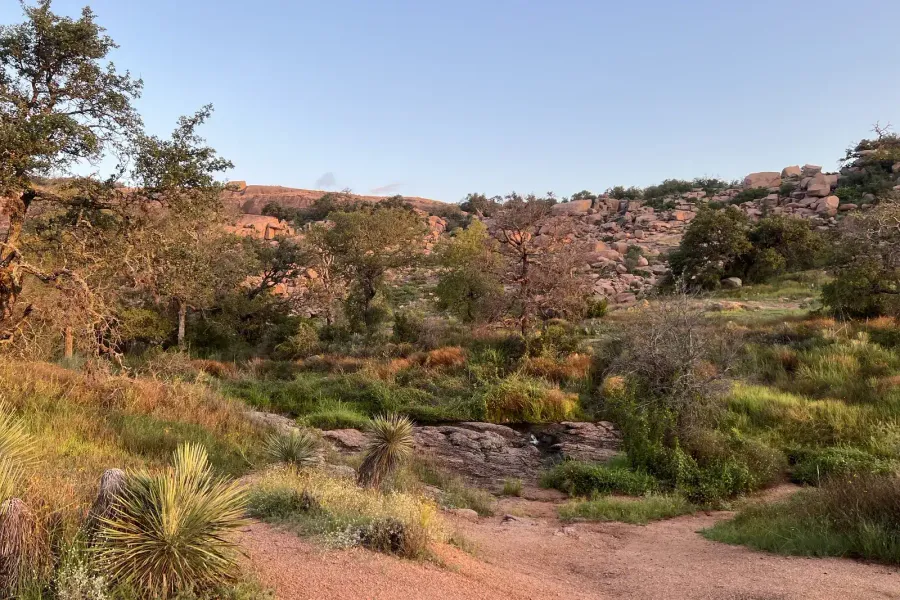
What is the ground like around Llano?
The uplift is not scenery here, it is the ground under the slab. Llano is one of its core counties, along with Blanco, Burnet, Gillespie, Mason, McCulloch and San Saba. Enchanted Rock, a massive pink granite dome rising above central Texas, is the picture most people have of this rock, and at the uplift's east edge, at Inks Lake State Park in Burnet County, pink Valley Spring gneiss, a Precambrian metamorphic rock, juts up through the limestone. On a lot the same family of rock is whatever your excavator hits, at whatever depth, and where it sits is not something a map settles for you.
The river authority angle is the part that catches buyers out. Three of the five lakes named in the Lower Colorado River Authority's on-site sewage rules, Buchanan, Inks and LBJ, are in this county, and the authority draws its jurisdiction as a measured zone rather than a shoreline. So an address near the water can end up at a different septic office than an address out in the interior, and the Llano River gives the county a fourth water body to check an address against. Checking whether a Highland Lakes lot will work is a step here, not a formality.
The lot, not the building, is where this county sets the price. Rock depth decides the septic design, the pad, the trenching and the post holes, which makes the site line on a Llano County bid the volatile one and the building the predictable half. Price it before you sign. Land and lot evaluation turns the rock, the septic route, the driveway, the power run and the well into a number, and what a barndominium costs in Central Texas shows how the pieces stack.
What that changes is the septic evaluation, the foundation and the pad. What it does not change is the process: a soil evaluation on the specific building site decides the septic system, and the slab is engineered for what is under it. The lot guide is the full checklist.
What does a barndominium lot in Llano County run into first?
Rock at the trench line. The uplift's Precambrian granite and metamorphic rock is what the trench, the pad and the post holes have to get through, and the depth to it is a lot-by-lot question rather than a plan-level one. Ask any bid whether rock excavation is included, excluded, or carried as an allowance.
The septic office follows the address, not your preference. A lake lot can land with the river authority while the next road over stays with the county, and Horseshoe Bay is a third agent on top of that. Look the address up on the river authority's jurisdiction map before you assume anything.
The ten-acre state septic exemption does not help you here. It is set aside on both sides of the line: the county permits every system whatever the size of the tract, and inside the river authority's zone a permit is required before any system is constructed or installed no matter the lot size.
Part of this county sits inside the Highland Lakes Watershed Ordinance, which regulates clearing, excavating, grading, contouring and filling, not just buildings. The site work can trigger it before the house does, and eleven local governments administer parts of it, so the river authority may not be the office that applies to your tract.
The contract is your inspection schedule. No county code review reaches the structure here, so the only inspections that happen are the ones you name in the agreement with your independent builder, with the stages named and payment tied to the reports.
Clearing and fire are one decision, and rock tightens it. The ignition zones are measured out from the structure, so the cheapest place to excavate and the place that gives you clearance are not always the same spot. Settle the pad against both before the site plan is fixed, and ask Llano County where any burn ban stands before you plan to burn what you clear.
Which towns and areas does this cover?
Llano is the county seat. Places in and around Llano County include Llano, Kingsland, Horseshoe Bay, Buchanan Dam, Tow, Sunrise Beach Village, Castell, Valley Spring. Town pages: Llano. Anywhere in the county outside a city's limits and extraterritorial jurisdiction follows the county's answer above; inside a city, the city's building department applies.
Next on the chain: Burnet County. Every county's status: do I need a building permit in Central Texas. All six rows with sources: the permit directory.
Questions people ask about Llano County
- My lot is near Lake LBJ. Do I apply to the county or to the river authority for septic?
- It depends on where the address falls, and you can check it rather than guess. LCRA regulates on-site sewage facilities within 2,200 feet of the upper Highland Lakes, built as a Restricted Zone at each lake plus a Water Quality Zone extending 2,000 feet horizontally beyond that Restricted Zone's outer boundary. Buchanan, Inks and LBJ are all named in those rules. LCRA publishes an address-searchable OSSF and watershed jurisdiction map. If the address is outside that zone, the county is your agent; inside Horseshoe Bay the city is a third authorized agent.
- I have a tract over ten acres. Does the state septic exemption apply here?
- No. The state rule does exempt a single-family system on a tract of ten acres or larger when it meets the construction standards, keeps all parts at least 100 feet from the property line, disposes of effluent on the property and is the only dwelling on the tract. But a local authorized agent may adopt standards stricter than state law, and those stricter standards control. The county permits every system whatever the tract size, and inside LCRA's jurisdiction a permit is required before any system is constructed or installed no matter the lot size.
- If nobody from the county inspects the house, does anything get inspected?
- Only what you put in the contract, unless the lot is inside a city with its own code. The state does not license home builders or general contractors, and the Texas Residential Construction Commission was abolished when its Act expired on September 1, 2009. The county code standards subchapter is opt-in, applying only to counties that adopt a resolution and meet a border or population test. The pattern worth writing into the contract is the one that statute uses: foundation before concrete, framing and mechanical before drywall, and completion, contracted with a qualified private inspector. Plumbers, electricians and septic installers are separately licensed by the state and can be verified.
- Is there anything I need before I clear trees or grade the site?
- Possibly, and it depends on the acreage and where the tract sits. Disturbing one acre or more, or a piece of a larger common plan that will, brings in the state construction stormwater permit. A portion of Llano County is inside the Highland Lakes Watershed Ordinance, which regulates clearing, excavating, grading, contouring and filling as well as buildings, with a permit required above 10,000 square feet of impervious cover and/or one acre of disturbance, and a written notification route below that. Eleven local governments administer parts of that ordinance, so confirm which office applies to your tract.
- Why do two similar lots in this county price so differently?
- Because the building is the predictable half and the ground is not. A price per square foot covers the structure and stops at it. Septic, driveway, power, water, rock and the pad are priced on the site itself. On the Llano Uplift the rock under the lot is Precambrian granite and metamorphic rock, and how deep it sits, along with the septic design that depth allows, is what moves the number between two lots on the same road. The cost guide carries the one builder figure this site publishes, dated and named as one builder's working range.
Four fields, no email
Get a free estimate for a build in Llano County
Your county and what you want to build. Free. No obligation. No fee to you at any point.
Tell us where the land is and what you want to build: the pad, the septic, the shell, the finish. Your request goes to one independent builder, and taking the project is their call.