
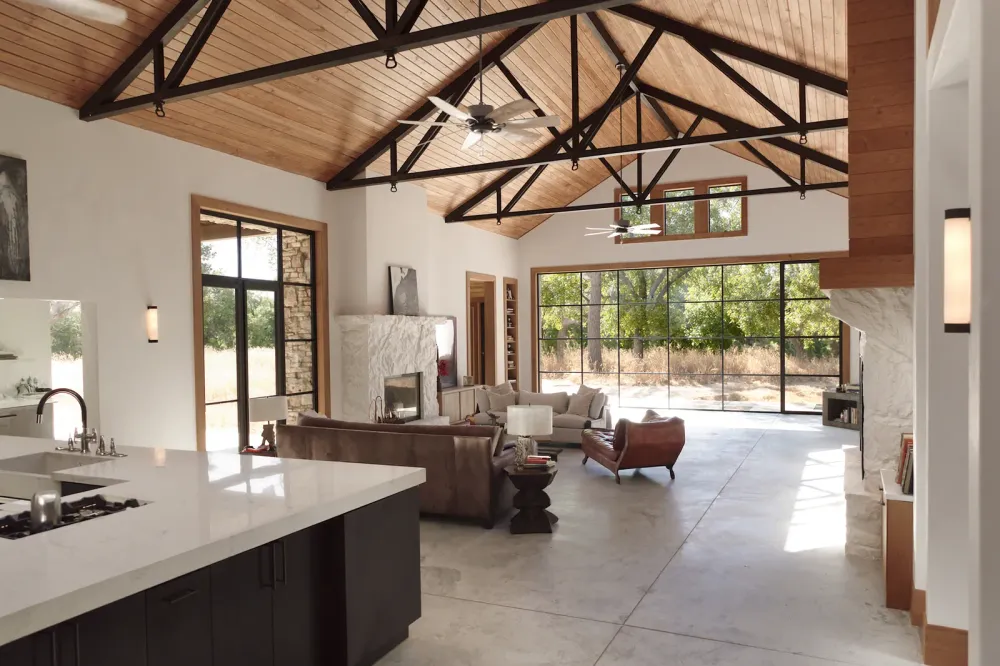
Who permits a barndominium in Lockhart, the city or Caldwell County?
Outside that line, Caldwell County requires a Residential Construction Permit. In the city's ETJ you get city subdivision and signage rules, not the full city code. The county permit is not a code permit, and the county inspects no framing. Find out which side your tract is on before you talk price with anyone, because it decides which office you file with and what the septic path looks like. Texas issues no state license for general contracting, so the builders you meet here are independent, and the checking is yours.
Start with the city line. Lockhart requires a permit for most building work that alters a structure or adds a new one, and construction of a new dwelling is first on its list. Inside the city limits the build follows the 2018 International Residential Code, adopted by Ordinance 2021-39, which replaced the 2015 edition. A barndominium inside that line is a code build with a city permit behind it.
Step outside and the answer changes twice. Property in Lockhart's extraterritorial jurisdiction is subject to city subdivision and signage regulations, not the full city code. An ETJ tract is still outside the city limits, which puts it in the unincorporated county, where Caldwell County requires a Residential Construction Permit for a new home. If you are not certain which of the three you sit in, ask Caldwell County Development Services and the City of Lockhart to each confirm your address before you order plans.
The county permit is not a code permit. Caldwell County does not inspect framing or electrical work. What it reviews is the paperwork around the lot: the recorded plat or a metes and bounds survey, the deed, tax certificates showing current taxes paid, a sketch of the proposed structure, the approved 911 address, and the approved county septic permit. The parcel has to be an original tract, a legally platted lot, or a tract exempt from platting, or the permit does not issue. The six-county permit guide sets that against the other five counties, and the Caldwell County permit page carries the rest.
City of Lockhart, Do I need a permit? FAQ, as read September 13, 2026.
City of Lockhart Council Packet, Ordinance 2021-39 (PDF, city-hosted), as read September 13, 2026.
City of Lockhart Construction Standards and Contractor License Information, as read September 13, 2026.
Caldwell County Development Ordinance, revised February 14, 2023, as read September 13, 2026.
What does the City of Lockhart charge to permit and hook up a new house?
Lockhart rewrote its fees this fall. Ordinance 2026-36 put every department's charges into one FY 2026-2027 Comprehensive Fee Schedule, in force since September 16, 2026, the first time the city has kept them in a single document. Inside the limits a new dwelling is billed by floor area at $0.45 a square foot, and plan check adds half of that again. A 2,000 square foot house therefore carries a $900 building permit and a $450 plan check before any trade work. An accessory dwelling unit is billed at the same rate per foot.
The trades are flat. New-construction plumbing, electrical and mechanical permits are $125 apiece, so is the meter loop, and so are a detached garage or carport, a storage building and a residential driveway. A permit that has to be renewed costs $75, and every failed inspection that brings an inspector back costs $150, which is a reason to call for each inspection only when the work is ready.
Connecting to city service is priced separately. Lockhart runs its own electric, water and wastewater utilities. Its schedule sets a $200 residential electric tap for overhead service, a water tap from $750 for a 3/4 inch line plus the meter and its radio unit, and a sewer tap of $1,200 for a 4 inch line. The city also posts impact fees of $4,562.36 for water and $5,792.42 for wastewater per living unit equivalent; ask the utility department in writing which apply to your tap, because together they outweigh the taps several times over. Where a main has to be brought to the lot, the city reviews the off-site extension at $1 a foot, each utility counted on its own.
The monthly bill has a shape worth knowing before you size the meter. Water on a 5/8 inch meter starts at a $44.46 fixed charge, with the first 1,999 gallons free and residential use priced in rising tiers from $7.87 to $22.11 per 1,000 gallons, so irrigating a big yard costs real money. Wastewater adds $20.34 plus $6.12 per 1,000 gallons from 2,000 gallons. A customer outside the city limits pays $5 a month more on water and $2 more on electric. None of this reaches a tract on a water supply corporation or a private well; the Caldwell County permit page covers that side.
City of Lockhart Fee Schedule page and FY 2026-2027 Comprehensive Fee Schedule (Exhibit B), Building Inspections and Enforcement, as read October 28, 2026.
City of Lockhart Fee Schedule page and FY 2026-2027 Comprehensive Fee Schedule (Exhibit B), Water, Wastewater and Electric Distribution, as read October 28, 2026.
City of Lockhart FY 2026-2027 Comprehensive Fee Schedule (Exhibit B), as read October 28, 2026.
Which Caldwell County offices sign off on a Lockhart build?
Four, and the county chains three of them together. The 911 address is what the septic permit requires, and the approved septic permit is one of the papers the Residential Construction Permit requires. Start at the address end of that chain, not the building end.
Building: Caldwell County Development Services issues the Residential Construction Permit under the county Development Ordinance. It checks the lot's legal status and the paperwork and does not inspect the structure.
Septic: the Caldwell County Sanitation Department is the state's authorized agent. It requires an application, permit and inspection whatever the size of the tract, which sets aside the state acreage exception. Minimum lot size is one acre, and only a licensed installer may build the system.
Floodplain: the Caldwell County Director of Sanitation is the county Floodplain Administrator. Every piece of construction or other development needs a floodplain development permit in the mapped flood zones, manufactured homes included.
Driveway: the Caldwell County Unit Road Department issues the driveway permit, and it stays in force even on a tract exempt from platting.
Caldwell County Development Ordinance, revised February 14, 2023, as read September 13, 2026.
Does the Lower Colorado River Authority permit septic near Lockhart?
No. The river authority is a TCEQ authorized agent in Travis, Burnet and Llano counties, around the Highland Lakes, and it does not appear in Caldwell County. The lake rules that govern a septic system near Lake Travis or Lake Buchanan do not reach a Lockhart tract.
Caldwell County has five authorized agents in all: the county for the unincorporated area, plus the cities of Mustang Ridge, San Marcos, Uhland and Niederwald for their own city limits. Lockhart is not one of them. Ask the Caldwell County Sanitation Department who holds the septic file for your address rather than assuming the city does. TCEQ also publishes a county search that returns every authorized agent and the area each one serves.
A permit is needed before anyone builds, installs, alters, extends or repairs a septic system, and local programs may be stricter than the state minimum. The septic permit guide walks the application, the site evaluation and the design.
TCEQ OARS county search, identical entry returned for Travis, Burnet and Llano counties, as read September 13, 2026.
TCEQ OARS county search, Caldwell County (CNTY_CD 28), as read September 13, 2026.
TCEQ On-Site Activity Reporting System, search by county, as read September 13, 2026.
TCEQ, Getting a Permit for an On-Site Sewage Facility, as read September 13, 2026.
Caldwell County Development Ordinance, revised February 14, 2023, as read September 13, 2026.
What decides the foundation under a Lockhart tract?
The soil report on your address, not a regional map. Nothing in the public record ties any one tract here to a soil type, so order the test before you take a price from anyone.
Two regional descriptions on the state record are worth reading while you wait. The Blackland Prairies region is named for its deep, fertile black soils, on land gently rolling to nearly level at 300 to 800 feet, and most of the original prairie has been plowed. Houston Black, the soil that names the region, formed in clayey residuum weathered from calcareous mudstone of Upper Cretaceous age, mostly on 1 to 3 percent slopes. Dry, it cracks 0.5 to 4 inches wide from the surface down 12 inches or more. That is shrink and swell. If your report names it, that is the first thing to put in front of whoever designs your foundation.
The Post Oak Savannah is the other, oak woodland patches mixed with grassland, gently rolling to hilly at the same 300 to 800 feet. Its uplands are sands and sandy loams with clay or clay loams in the bottoms, and a dense clay pan almost impervious to water sits under all of those types at only a few feet deep. Water that cannot get down is a septic question as much as a foundation one. Ask the Caldwell County Sanitation Department what the site evaluation on your address found, because the county will not issue the Residential Construction Permit without the approved septic permit behind it.
Texas Parks and Wildlife Department, Texas Ecoregions, as read September 13, 2026.
USDA NRCS, Official Series Description, Houston Black Series, as read September 13, 2026.
Texas Parks and Wildlife Department, as read September 13, 2026.
Caldwell County Development Ordinance, revised February 14, 2023, as read September 13, 2026.
Can you drill a house well on land around Lockhart?
Usually, but the groundwater district comes first. The Plum Creek Conservation District, with its office on West San Antonio Street in Lockhart, regulates wells in the parts of Caldwell and Hays counties inside its boundaries. Those boundaries follow the original survey calls, not the county line, so ask the district whether your tract is in before the driller is booked. Plum Creek itself drains about 310 square miles, roughly six tenths of the county.
Inside the district every well is registered, exempt or not, and the fee schedule amended November 18, 2025 charges nothing for that registration. A well serving only a household needs no operating permit if it is built so it can never pump more than 25,000 gallons in a day, and the district cannot then limit what it draws. The stock-well exemption needs a tract of more than ten acres, but the household exemption in the district rules is written without that acreage test. It is lost if the well ends up supplying a subdivision that needs a county plat, and enlarging the well or changing what the water is used for needs an application.
The harder question is what the well will find. The district's management plan is blunt about the shallow formations: much of the Leona gravel carries nitrate levels it does not recommend for people or livestock, and in the Pecan Gap chalk many wells eventually go dry. The plan names the Carrizo sands a major irrigation and municipal aquifer and the Wilcox a household, livestock and municipal source over a wide area, where either lies under a tract. Ask the driller which formation the neighbors' wells draw from, test the water before the house is plumbed to it, and make sure the driller files the well log and completion report with the district, as its rules require.
Plum Creek Conservation District Rules (adopted as amended November 20, 2018), Preamble and Rule 1; Groundwater Management Plan as amended August 15, 2023, sections 3 to 5, as read October 28, 2026.
Plum Creek Conservation District Rules, Rules 4.A and C and 10.A to C; Deposits and Fees Schedule amended 11-18-2025, as read October 28, 2026.
Does a Lockhart barndominium need an Edwards Aquifer plan?
No. The Edwards Aquifer Protection Program covers eight Texas counties, which run from Williamson and Travis through Hays, Comal, Bexar, Medina and Uvalde to Kinney. Caldwell is not among them, so a build in Lockhart needs no aquifer plan of either kind, recharge or contributing zone, and no aquifer review holds up the site work.
That is a real difference between the south end of this area and the west side of it. TCEQ's Austin Regional Office handles the program for Williamson, Travis and Hays counties; its number is (512) 339-2929. If a builder or a lender tells you a Lockhart tract needs an aquifer plan, that is the office to call.
TCEQ GIS metadata, Edwards Aquifer Recharge Zone - Chapter 213 Rules (TSMS), quoting 30 TAC 213.3(8), as read September 13, 2026.
TCEQ Edwards Aquifer Protection Program home page, as read September 13, 2026.
TCEQ, Water Pollution Abatement Plan page, as read September 13, 2026.
TCEQ, Contributing Zone Plan page, as read September 13, 2026.
What else does a Lockhart lot have to clear?
Three things: the floodplain elevation rule, the driveway permit, and whether your tract is platted or exempt. A home inside or within 300 feet of a floodplain must have its first finished floor at least two feet above the adjoining base flood elevation, with an elevation certificate. Read that 300 feet carefully: you can sit outside the mapped zone and still be caught by the rule. The FEMA Flood Map Service Center is the official public source for flood hazard information under the National Flood Insurance Program, searchable by address, place name or coordinates, so check it before you make an offer.
Land surveyors, architects and engineers authorized by law certify the elevation information on the certificate. The certificate itself is an NFIP tool used to set the flood insurance premium rate and to document elevation for compliance with local floodplain management rules. Caldwell County requires a plat unless the tract is exempt, and an exempt tract still needs all of it: the Residential Construction Permit, the septic permit, the floodplain permit where it applies, the driveway permit from the Unit Road Department, and the 911 address. If your site work will disturb one acre or more, or belongs to a larger common development plan that will, the TPDES Construction General Permit applies. Below one acre, no coverage is required.
None of that shows up in a price per square foot. The Central Texas cost guide separates the building from the site so you can see what you are paying for. If your search crosses north out of the county, the picture changes again: the town of Bastrop sits under a county that issues a development permit and requires three private inspections.
FEMA Flood Map Service Center, as read September 13, 2026.
FEMA 467-1, Floodplain Management Bulletin: Elevation Certificate, as read September 13, 2026.
FEMA, Elevation Certificate FAQ, October 2023, as read September 13, 2026.
TCEQ, Stormwater Discharges from Construction Activities: Am I Regulated?, as read September 13, 2026.
Caldwell County Development Ordinance, revised February 14, 2023, as read September 13, 2026.
Bastrop County Development Services, as read September 13, 2026.
How do you check barndominium builders near Lockhart?
Texas issues no state license for general contracting, though a city or county may still have requirements of its own. The Texas Residential Construction Commission no longer exists: it was abolished, and its enabling Act lapsed on September 1, 2009, so there is no state registry of home builders to search. Every builder here is independent, and the checking is yours to do.
The one credential Caldwell County forces is on the septic side, and it sits directly in your permit path, because the approved septic permit is one of the papers the Residential Construction Permit requires.
Septic installers are licensed or registered by TCEQ, which runs a public license lookup. Installer I covers standard systems, Installer II covers all system types. Caldwell County requires a licensed installer, so this one is not optional.
Plumbers hold state licenses from the Texas State Board of Plumbing Examiners, which publishes a public license lookup.
Electricians are licensed by the state through TDLR, and non-exempt electrical work must be done through a licensed electrical contractor. TDLR runs a license search.
Office of the Texas Governor, Business Permit Office, Texas Business Licenses and Permits Guide, as read September 13, 2026.
Texas Sunset Advisory Commission, as read September 13, 2026.
TCEQ, Occupational Licenses: On-Site Sewage Facilities (Septic Systems), as read September 13, 2026.
TCEQ, On-site Sewage Facilities: Information for Regulators, as read September 13, 2026.
Texas State Board of Plumbing Examiners, as read September 13, 2026.
Texas State Board of Plumbing Examiners, as read September 13, 2026.
Texas Department of Licensing and Regulation, Electricians program, as read September 13, 2026.
Texas Department of Licensing and Regulation, as read September 13, 2026.
Caldwell County Development Ordinance, revised February 14, 2023, as read September 13, 2026.
Your next three calls
Call Caldwell County Development Services first and ask two things: is my address inside the Lockhart city limits, in the city's ETJ, or in the unincorporated county, and is my parcel an original tract, a legally platted lot, or exempt from platting. Those two answers decide everything downstream.
Call the Caldwell County Sanitation Department next about the septic permit and ask what the 911 address step requires, because the septic permit needs the address and the Residential Construction Permit needs the septic permit. Call the Caldwell County Unit Road Department third about the driveway, and ask whether your access road is county maintained.
Then read the full guide to building a barndominium in Central Texas, which puts these answers next to what the other five counties in the area require. What the build itself involves, shell through finish, is on the turnkey barndominium construction page.
Caldwell County Development Ordinance, revised February 14, 2023, as read September 13, 2026.
Close by: Luling, Martindale, Dale, Maxwell, Prairie Lea, Fentress. The whole county: Caldwell County. The next town along: Bastrop.
Lot and permit questions near Lockhart
Do I need a City of Lockhart permit if my land is in the ETJ?
Property in Lockhart's ETJ is subject to city subdivision and signage regulations, not the full city code. An ETJ tract is outside the city limits, which puts it in the unincorporated county, where Caldwell County requires a Residential Construction Permit for a new home. Confirm your address with Caldwell County Development Services and with the City of Lockhart before you order plans.
Who issues the septic permit for a barndominium near Lockhart?
The Caldwell County Sanitation Department, as the state's authorized agent. It requires an application, permit and inspection whatever the size of the tract, which sets aside the state acreage exception. Minimum lot size is one acre, only a licensed installer may build the system, and the approved septic permit is one of the papers the county's Residential Construction Permit requires. The Lower Colorado River Authority is not an authorized agent in Caldwell County.
Does Caldwell County inspect the framing on a new house?
No. The Residential Construction Permit is not a building code permit, and the county does not inspect framing or electrical work. It reviews the plat or survey, the deed, tax certificates showing current taxes paid, a sketch of the structure, the approved 911 address and the approved septic permit. Inside the Lockhart city limits it is different: the city permits the build and has adopted the 2018 International Residential Code.
How close to a floodplain triggers extra rules on a Lockhart-area lot?
A home inside or within 300 feet of a floodplain must have its first finished floor at least two feet above the adjoining base flood elevation, with an elevation certificate. Every piece of construction or other development needs a floodplain development permit in the mapped flood zones, manufactured homes included, and the Caldwell County Director of Sanitation is the county Floodplain Administrator. Check the FEMA Flood Map Service Center by address before you make an offer.
Barndominium estimate, no charge
Price a house on land near Lockhart
A minute of typing: the county, the kind of house, the timing.
Say which county your acreage is in and what should stand on it, a finished home, a shell, a shop with living quarters. It goes to one independent builder, who decides whether to take the project on.