
Does Williamson County require a building permit for a barndominium?
Williamson County says it in its own words: Texas counties have not been given general zoning authority by the state legislature, so the county does not deal with most site plans or issue building permits except for health and safety issues, and the county has no authority to zone property for land use nor to issue a certificate of occupancy. It has also not adopted the optional county residential building code standards the Local Government Code makes available, so it sets no building code for the unincorporated county and inspects no houses. What it does require before a new home goes up is a Certificate of Compliance from the County Engineer’s office, which is the floodplain check, and that has to be in hand before a septic application will be processed. A lot in a recorded subdivision may already carry one in its plat notes.
Source: Williamson County frequently asked questions, County Engineer, read 2026-09-13.
Inside city limits, the city's own building department applies whatever the county does, and a city's extraterritorial jurisdiction can add platting and environmental rules outside its limits. The first question about any lot is which of the three it is in.
Who do I call in Williamson County to confirm?
Williamson County Engineer, Road and Bridge Division, 512-943-3330, 3151 SE Inner Loop, Suite B, Georgetown. Ask whether the county requires a permit for a new single-family home outside city limits and whether it inspects. That call takes five minutes.
Other county permits the official site shows:
- Certificate of Compliance from the County Engineer, before construction and before the septic application
- On-site sewage facility (septic) permit
- Floodplain development permit in or beside the 100-year floodplain
- County driveway permit onto a county-maintained road
- 911 address from county GIS and Addressing, needed before a county permit application
- Plat, where a tract outside city limits is divided
Which jurisdiction is your Williamson County lot actually in?
This is the first question on a lot here and it is not rhetorical. The cities reach well past their city lines, and what they do out there is not the same from city to city. Work out three things from the address before anything else: are you inside a city, are you inside an extraterritorial jurisdiction, and if so whose. The six-county picture sits in the guide to building a barndominium in Central Texas.
Inside Georgetown, a permit is required to construct, enlarge, alter, repair, move, demolish or change occupancy of a building, or to work on electrical, gas, mechanical or plumbing systems, under the 2021 International Residential Code effective November 1, 2023. In the Georgetown ETJ the City reviews subdivision of land, stormwater, utility evaluation, driveway permits and sign permits. The part people miss: Georgetown building permits do apply in that ETJ when the City is the water, wastewater or electric provider, covering new construction, plumbing, electrical and utility connections.
Leander and Liberty Hill draw the line elsewhere. Leander requires a permit before any construction starts inside the city limits, under the 2021 International Residential Code for One and Two-Family Dwellings plus the 2023 National Electrical Code with local amendments, but in the Leander ETJ the only permits are for signs and water or wastewater connections. Liberty Hill requires a building permit for any construction that physically changes or adds structures, under the 2021 International Residential Code, and that permit expires after 180 days unless construction continues or an extension is granted. In the Liberty Hill ETJ you get subdivision and sign regulations, possible platting and stormwater permits, and City building permits only where a development agreement is in place for the property.
Georgetown: full city permits inside the limits, and building permits in the ETJ wherever the City supplies water, wastewater or electricity.
Leander: full permits inside the limits, signs and utility connections only in the ETJ.
Liberty Hill: full permits inside the limits, and in the ETJ only under a development agreement. The city permit runs 180 days.
Austin's extraterritorial jurisdiction reaches into Williamson County, so check whose ETJ the address falls in before you assume it is in none.
Source: City of Georgetown Development Services, When do I need a Permit?, read 2026-09-13.
Source: City of Georgetown Development Services, Adopted Building Code, read 2026-09-13.
Source: City of Georgetown Development Services, Extra-Territorial Jurisdiction (ETJ) and City Limits, read 2026-09-13.
Source: City of Leander, Permits and Building Inspection, read 2026-09-13.
Source: City of Leander, Building Codes, read 2026-09-13.
Source: City of Liberty Hill, Building Permits and Inspections, read 2026-09-13.
Source: City of Liberty Hill, Frequently Asked Questions (Planning and Development), read 2026-09-13.
Source: City of Austin Planning, Jurisdictional Matters, read 2026-09-13.
Source: Williamson County frequently asked questions, County Engineer, read 2026-09-13.
Is the lot over the Edwards Aquifer, and which zone?
Williamson is one of eight Texas counties inside the Edwards Aquifer Protection Program, with Kinney, Uvalde, Medina, Bexar, Comal, Hays and Travis. In the Austin region the program covers Williamson, Travis and Hays, run out of the TCEQ Austin Regional Office at (512) 339-2929; the other five report to San Antonio. Only two of the six counties this site covers are in the program, Williamson and Travis County, which is why the aquifer question lands on a Williamson County lot and never on a Burnet County one.
Three zones matter and they are not equal. The recharge zone is where the Edwards rock units crop out, plus nearby outcrops with caves, sinkholes, faults or fractures that could carry surface water down. There, a Water Pollution Abatement Plan is required for any regulated activity and has to be approved before construction starts, with no acreage floor of any kind. The contributing zone is the watershed upgradient, generally north and northwest, and in Williamson County it is all areas except the watersheds draining to the Lampasas River above Stillhouse Hollow dam. There a Contributing Zone Plan is triggered at five acres of disturbance, or where the work is part of a larger plan of development or sale, and below that no Edwards plan is needed. The transition zone lies south and southeast of the recharge zone, where other formations crop out and faults or fractures give water a possible path in.
Two traps. A site sitting partly on the contributing zone and partly on the recharge zone is treated as recharge zone in full, and a transition zone site that drains back to the recharge zone escalates the same way. And the clock is real: administrative review runs up to 30 days, technical review of an administratively complete application runs 90 days, and construction cannot begin until approval issues. A single-family residence may avoid needing its own plan if it sits in a master community with an approved plan, or on a lot larger than five acres with only that one residence, or keeps impervious cover to 20 percent or less of the legal property. Check the parcel on the TCEQ Edwards Aquifer Map Viewer and print the map for the file. The zone-by-zone detail is in the Edwards Aquifer contributing zone guide.
Source: TCEQ GIS metadata, Edwards Aquifer Recharge Zone - Chapter 213 Rules (TSMS), quoting 30 TAC 213.3(8), read 2026-09-13.
Source: TCEQ Edwards Aquifer Protection Program home page, read 2026-09-13.
Source: TCEQ GIS metadata, quoting 30 TAC 213.3(25), read 2026-09-13.
Source: TCEQ GIS metadata, quoting 30 TAC 213.22(2), read 2026-09-13.
Source: TCEQ GIS metadata, quoting 30 TAC 213.3(34), read 2026-09-13.
Source: TCEQ, Water Pollution Abatement Plan page, read 2026-09-13.
Source: TCEQ, What Plans You Might Need, recharge zone branch, read 2026-09-13.
Source: TCEQ, Contributing Zone Plan page, read 2026-09-13.
Source: TCEQ, Edwards Aquifer Protection Program: What Plans You Might Need, read 2026-09-13.
Source: TCEQ, What Plans You Might Need, contributing zone branch, read 2026-09-13.
Source: TCEQ, Edwards Aquifer Private Residences page, read 2026-09-13.
Source: TCEQ, Edwards Aquifer Map Viewer page, read 2026-09-13.
Source: Texas Water Development Board, read 2026-09-13.
Source: Williamson County frequently asked questions, County Engineer, read 2026-09-13.
Why do two Williamson County lots quote so differently?
Mostly the ground, and the two kinds of ground in play are nothing like each other. The Edwards Plateau is shallow soils underlain by limestone, with many springs, stony hills and steep canyons. Faulting along the Balcones Fault Zone followed the uplift of that plateau, and streams crossing the zone recharge the aquifer where dissolution has opened the limestone, which is the reason a state aquifer program has an interest in this county at all. Where a parcel sits on the recharge zone, the Edwards rock units crop out there, and everything that goes into the ground is going into stone.
The Blackland Prairies are the opposite problem: deep, fertile black soils, gently rolling to nearly level at 300 to 800 feet, with most of the original prairie long since plowed. Houston Black soil formed in clayey residuum weathered from calcareous mudstone of Upper Cretaceous age, mainly on one to three percent slopes. When it dries it cracks half an inch to four inches wide from the surface down 12 inches or more, and it swells shut when the rain returns. A foundation on that is an engineering decision, not a thickness decision.
No website can tell you which of those is under your parcel, and a builder quoting from a floor plan cannot either. Get a soils report, then ask any independent builder to state in writing which soil the foundation design assumes and who did the soils work. That question belongs in the contract, not the conversation, because two quotes built on different soil assumptions are not comparable at all. Barndominium construction starts from the lot, not the floor plan.
Source: Texas Parks and Wildlife Department, Texas Ecoregions, read 2026-09-13.
Source: USGS, Karst Aquifers: Edwards Balcones Fault Zone Aquifer, read 2026-09-13.
Source: TCEQ GIS metadata, quoting 30 TAC 213.3(25), read 2026-09-13.
Source: TCEQ GIS metadata, Edwards Aquifer Recharge Zone - Chapter 213 Rules (TSMS), quoting 30 TAC 213.3(8), read 2026-09-13.
Source: USDA NRCS, Official Series Description, Houston Black Series, read 2026-09-13.
Source: Williamson County frequently asked questions, County Engineer, read 2026-09-13.
What does the septic side here do that the neighboring counties do not?
One authorized agent covers the entire county. No city and no special district is separately authorized, and the Lower Colorado River Authority, which runs septic permitting inside its water quality zones on the lake lots in Burnet County, does not appear in Williamson at all. Travis County has seven agents to sort between and Burnet has eight. Here there is one, the statutory clock is 30 days from receipt to an approval or a written denial, and a denial comes with a written explanation and an appeal to the supervisory body.
Acreage does not obviously buy you out of it, and this is the question worth asking before you plan around anything. The state exemption in 30 TAC 285.3 is narrow and conditional: a tract of ten acres or larger, a single family dwelling that is the only dwelling on the tract, full Subchapter D construction standards, no nuisance or groundwater pollution, every part of the system at least 100 feet from the property line, and effluent disposed of on the property. Every one of the other five counties on this site permits septic whatever the size of the tract. The Williamson record does not say how it treats that exemption, and a local authorized agent may adopt standards stricter than state law or TCEQ rules, with each stricter requirement justified in writing on public health grounds and reviewed by the TCEQ executive director. Ask the County Engineer's office directly.
The trades are the licensed part of this job. Only a TCEQ-licensed or registered installer may build the system, Installer I for standard systems and Installer II for all types, checkable in TCEQ's public license lookup. Plumbers are licensed by the Texas State Board of Plumbing Examiners and verified through its public lookup. Electricians are licensed through TDLR, non-exempt electrical work has to run through a licensed electrical contractor, and TDLR's license search confirms it. Near water, land surveyors, architects and engineers are the people authorized to certify the FEMA elevation certificate. Those are the credential checks that exist on this build. There is no equivalent lookup for the builder, because the state does not license one. The septic permit guide and the six-county permit guide walk the paperwork step by step.
Settle the jurisdiction first: city limits, a city ETJ, or unincorporated, and which city's ETJ it is.
Check the parcel against the TCEQ Edwards Aquifer Map Viewer and the FEMA Flood Map Service Center before you make an offer, not after closing.
On a recharge-zone parcel the Edwards plan is the long clock: up to 30 days of administrative review, then 90 days of technical review, and no construction until approval issues. Start it in parallel with everything else.
Ask the County Engineer's office how it treats the state ten-acre septic exemption before you buy acreage expecting it.
If ground disturbance will reach one acre, or the lot is part of a larger common plan of development that will, add construction stormwater coverage under the state general permit. Below an acre, none is required.
Source: TCEQ OARS county search, Williamson County (CNTY_CD 246), read 2026-09-13.
Source: TCEQ OARS county search, Travis County (CNTY_CD 227), read 2026-09-13.
Source: TCEQ OARS county search, Burnet County (CNTY_CD 27), read 2026-09-13.
Source: TCEQ OARS county search, identical entry returned for Travis, Burnet and Llano counties, read 2026-09-13.
Source: TCEQ On-Site Activity Reporting System, search by county, read 2026-09-13.
Source: TCEQ, Getting a Permit for an On-Site Sewage Facility, read 2026-09-13.
Source: TCEQ adopted rule text, 30 TAC Chapter 285, Rule Project No. 2021-030-285-CE, section 285.3, read 2026-09-13.
Source: Texas Health and Safety Code Sec. 366.032(b), read 2026-09-13.
Source: TCEQ publication RG-472, On-Site Sewage Facility Rules Compilation, 30 TAC 285.10(b)(4), read 2026-09-13.
Source: TCEQ publication RG-472, 30 TAC 285.10(a), read 2026-09-13.
Source: TCEQ, Occupational Licenses: On-Site Sewage Facilities (Septic Systems), read 2026-09-13.
Source: TCEQ, On-site Sewage Facilities: Information for Regulators, read 2026-09-13.
Source: Texas State Board of Plumbing Examiners, read 2026-09-13.
Source: Texas State Board of Plumbing Examiners, read 2026-09-13.
Source: Texas Department of Licensing and Regulation, Electricians program, read 2026-09-13.
Source: Texas Department of Licensing and Regulation, read 2026-09-13.
Source: Office of the Texas Governor, Business Permit Office, Texas Business Licenses and Permits Guide, read 2026-09-13.
Source: TCEQ Edwards Aquifer Protection Program home page, read 2026-09-13.
Source: TCEQ, Edwards Aquifer Map Viewer page, read 2026-09-13.
Source: FEMA glossary, Permit for Floodplain Development, read 2026-09-13.
Source: FEMA 467-1, Floodplain Management Bulletin: Elevation Certificate, read 2026-09-13.
Source: FEMA, Elevation Certificate FAQ, October 2023, read 2026-09-13.
Source: FEMA Flood Map Service Center, read 2026-09-13.
Source: TCEQ, Stormwater Discharges from Construction Activities: Am I Regulated?, read 2026-09-13.
Source: Williamson County frequently asked questions, County Engineer, read 2026-09-13.
Source: Travis County Transportation and Natural Resources, Development Services, read 2026-09-13.
Source: Burnet County On-Site Sewage Facilities and Development Services, read 2026-09-13.
Source: Llano County Development Services, read 2026-09-13.
Source: Bastrop County Development Services, read 2026-09-13.
Source: Caldwell County Development Ordinance, revised February 14, 2023, read 2026-09-13.
If the county inspects nothing, what protects the build?
Start from the honest position. Texas does not require a state license to work as a general contractor, though local city or county requirements may still apply. The Texas Residential Construction Commission was abolished and its enabling Act expired on September 1, 2009, so there is no state body holding workmanship standards either. On an unincorporated lot in this county that leaves one document standing: the contract.
It is worth knowing exactly what the county has passed on. The Local Government Code offers counties a residential building code option, and it is opt-in, never automatic: Subchapter F applies only where a county has first adopted a resolution or order opting in and also meets the border or population test. In a county that has opted in, new residential construction in the unincorporated area must meet the International Residential Code as published May 1, 2008, or the version in force in that county seat, and a new house or duplex on a vacant lot needs at least three inspections: foundation before concrete, framing and mechanical before drywall, and on completion. Even then the county cannot require permission before construction starts and gains no zoning power, and the builder, not the county, contracts the inspections from one of six listed qualified persons, using one inspector throughout or a different one each time. Two of the six counties on this site operate that way. Williamson is not one of them.
So buy the inspections that the two opt-in counties get by default. Nothing stops an owner from hiring a qualified third-party inspector at those same three stages, foundation before concrete, framing and mechanical before drywall, and completion, and tying contract payments to passing them. Put the foundation design and the soil assumption it came from into the drawings, because on this side of the county line the drawings are the enforcement. An owner-builder putting up their own primary residence, or acting as their own contractor on it, is not penalized for failing to give the statutory notices, which cuts both ways: fewer formalities to trip over, and fewer defaults to fall back on when something goes wrong.
On money, a per-square-foot number covers the building and leaves out exactly what varies most on a Williamson County lot: septic, driveway, power, water, rock and the pad, all priced on the site itself. Ask for those as separate line items, and read the cost guide, which carries the one builder figure this site publishes, before you compare two numbers. A land and lot evaluation is the cheapest way to find out what the ground under your budget is going to do to it.
Source: Office of the Texas Governor, Business Permit Office, Texas Business Licenses and Permits Guide, read 2026-09-13.
Source: Texas Sunset Advisory Commission, read 2026-09-13.
Source: Texas Local Government Code Sec. 233.152, read 2026-09-13.
Source: Texas Local Government Code Sec. 233.153(a), read 2026-09-13.
Source: Texas Local Government Code Sec. 233.153(d), read 2026-09-13.
Source: Texas Local Government Code Sec. 233.154(a)(1), read 2026-09-13.
Source: Texas Local Government Code Sec. 233.154(a)(3), read 2026-09-13.
Source: Texas Local Government Code Sec. 233.157(c), read 2026-09-13.
Source: Williamson County frequently asked questions, County Engineer, read 2026-09-13.
Source: Travis County Transportation and Natural Resources, Development Services, read 2026-09-13.
Source: Bastrop County Development Services, read 2026-09-13.
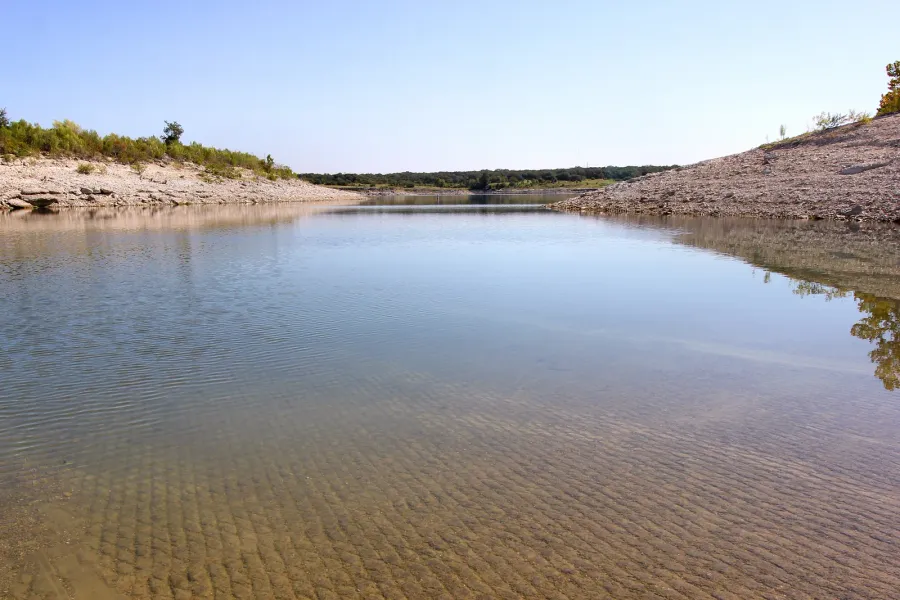
What is the ground like around Georgetown?
Two very different kinds of ground are in play in this part of Texas, and which one is under your pad is a parcel-level question that no page can answer for you. The Edwards Plateau is shallow soils underlain by limestone, with many springs, stony hills and steep canyons. Where a parcel sits on the Edwards recharge zone, the Edwards rock units crop out there by definition, so the pad, the septic trenches, the water line and the driveway culvert are all going into rock that is at or near the surface. How much of it has to come out is the number nobody can give you from the road.
The Blackland Prairies are the other kind of ground: deep, fertile black soils, gently rolling to nearly level at 300 to 800 feet, with most of the original prairie plowed long ago. Houston Black soil formed in clayey residuum weathered from calcareous mudstone of Upper Cretaceous age, mainly on one to three percent slopes, and its defining behavior is that it moves. Dry, it cracks half an inch to four inches wide from the surface down 12 inches or more, then swells shut when the rain comes back. On that, the foundation is an engineering decision and not a thickness decision, and the design is only as good as the soil number it assumed.
Water here means the San Gabriel River, Lake Georgetown and Granger Lake. Before you make an offer on anything near them, check the parcel on the FEMA Flood Map Service Center, the official public source for National Flood Insurance Program flood hazard information, searchable by address, place name or coordinates. Inside a Special Flood Hazard Area a permit is required before construction or development begins, and the elevation information is certified by a land surveyor, architect or engineer authorized by law. That certification is a real cost on a lot somebody bought for the view, and it is not inside anybody's per-square-foot building price.
What that changes is the septic evaluation, the foundation and the pad. What it does not change is the process: a soil evaluation on the specific building site decides the septic system, and the slab is engineered for what is under it. The lot guide is the full checklist.
What does a barndominium lot in Williamson County run into first?
Which jurisdiction the lot is in, before anything else. Georgetown, Leander and Liberty Hill each regulate something different past their city lines, and Austin's extraterritorial jurisdiction reaches into Williamson County as well. The same house can be a permitted city build on one lot and unpermitted ground across the fence.
A Georgetown ETJ lot on city utilities. Georgetown building permits do apply in its ETJ when the City is the water, wastewater or electric provider, and that pulls in new construction, plumbing, electrical and the utility connections. Find out who the utility provider is before you assume the lot is outside city permitting.
The Edwards Aquifer zone. Williamson is one of eight counties in the state protection program, and on the recharge zone there is no acreage floor at all: any regulated activity needs an approved Water Pollution Abatement Plan before construction starts, with technical review running 90 days.
One septic agent for the whole county. Williamson County is the single OSSF authorized agent here, with no city and no special district separately authorized and the Lower Colorado River Authority absent entirely. Travis has seven agents to sort between and Burnet has eight, so the one thing you do not have to work out here is who to apply to.
Whether ten acres actually exempts you. Every one of the other five counties on this site permits septic whatever the size of the tract. The Williamson record does not say how it treats the state exemption, so that is a question for the County Engineer's office and not an assumption to buy land on.
What the ground does to the site work. The foundation and the trenching are where two quotes stop being comparable, and neither one is inside a per-square-foot building number. Get the soils report first, then ask for the site work priced as its own line items.
Which towns and areas does this cover?
Georgetown is the county seat. Places in and around Williamson County include Georgetown, Liberty Hill, Leander, Cedar Park, Round Rock, Hutto, Taylor, Jarrell, Florence, Granger, Weir. Town pages: Georgetown, Liberty Hill, Leander. Anywhere in the county outside a city's limits and extraterritorial jurisdiction follows the county's answer above; inside a city, the city's building department applies.
Next on the chain: Burnet County and Travis County. Every county's status: do I need a building permit in Central Texas. All six rows with sources: the permit directory.
Questions people ask about Williamson County
- Do I need a building permit for a barndominium in unincorporated Williamson County?
- No county building permit. The trap is the word unincorporated: not every Williamson County address turns out to be. Georgetown, Leander and Liberty Hill all regulate past their city lines, and Georgetown building permits reach into its ETJ wherever the City is the water, wastewater or electric provider, covering new construction, plumbing, electrical and the utility connections. Settle which jurisdiction the address is in before you conclude anything from the county answer.
- Does the Edwards Aquifer program apply to my lot?
- It applies in Williamson County, and which zone the parcel sits in decides how much. On the recharge zone there is no acreage floor: any regulated activity needs an approved Water Pollution Abatement Plan before construction starts. In the contributing zone the trigger is five acres of disturbance, or being part of a larger plan of development or sale. A site straddling both is treated as recharge zone in full. Check the parcel on the TCEQ Edwards Aquifer Map Viewer, and budget the 90-day technical review into the schedule.
- Does a large tract get me out of the septic permit here?
- Do not assume so. The state's ten-acre exemption under 30 TAC 285.3 is conditional, not automatic: a single dwelling on the tract, every part of the system at least 100 feet from the property line, effluent disposed of on the property, full construction standards met, no nuisance. Every one of the other five counties on this site permits septic whatever the size of the tract, and a local authorized agent may adopt stricter standards that control. The Williamson record does not say how it treats the exemption, so ask the County Engineer's office before you buy acreage expecting it. Williamson has a single authorized agent covering the whole county, so there is only one office to ask.
- Can I act as my own builder?
- Yes, and no county inspector will check your work either way. An owner-builder building their own primary residence, or acting as their own contractor on it, is not penalized for failing to give the statutory notices. The licensed trades still bind: the septic installer must be licensed or registered by TCEQ, plumbers are licensed by the Texas State Board of Plumbing Examiners, and non-exempt electrical work has to run through a licensed electrical contractor under TDLR. All three are verifiable online. The builder is the one role with no license and no lookup, because Texas does not license one.
- Why do two builders quote the same house differently on two Williamson County lots?
- Usually the ground under it. Where a parcel sits on the Edwards recharge zone the rock units crop out there, so the pad, the septic trenches, the water line and the driveway culvert all go into stone. Where the soil is Houston Black clay, it cracks half an inch to four inches wide down 12 inches or more when dry and swells shut when wet, and the foundation design is what carries the money. A per-square-foot building price covers neither. Get the soils report, then make them quote the site work as separate line items.
Four fields, no email
Get a free estimate for a build in Williamson County
Your county and what you want to build. Free. No obligation. No fee to you at any point.
Tell us where the land is and what you want to build: the pad, the septic, the shell, the finish. Your request goes to one independent builder, and taking the project is their call.