
Does Travis County require a building permit for a barndominium?
Travis County is the strictest of the six and says so plainly: any development in Travis County requires a permit. The county defines development broadly, listing structures and buildings, driveways, work in the county right of way, on-site sewage facilities, dividing land, and mining, dredging, filling, grading, paving, excavation and clearing land to prepare a site. A new single-family home permit application states the International Residential Code year the build will follow, and where a professional builder does the work at least three inspections by a licensed third-party inspector are required: foundation before the concrete is placed, framing and mechanical before drywall, and completion of the residence. Manufactured homes still need the permit but are exempt from those inspections. The county’s residential construction standards apply to work begun after September 1, 2009.
Source: Travis County Transportation and Natural Resources, Development Services, read 2026-09-13.
Inside city limits, the city's own building department applies whatever the county does, and a city's extraterritorial jurisdiction can add platting and environmental rules outside its limits. The first question about any lot is which of the three it is in.
Who do I call in Travis County to confirm?
Travis County TNR Development Services permit desk, 512-854-4215, 700 Lavaca Street, Suite 540, Austin. Ask whether the county requires a permit for a new single-family home outside city limits and whether it inspects. That call takes five minutes.
Other county permits the official site shows:
- Basic development permit for any development outside city limits
- Special flood hazard area development permit where the lot is in the floodplain
- On-site sewage facility permit to construct, then a license to operate
- County driveway permit, or a TxDOT permit on a state road
- Three third-party construction inspections filed by a professional builder
Why does a builder's permit experience matter more here than a credential?
Texas does not require a state license to work as a general contractor, and the commission that once oversaw residential builders was abolished when its enabling Act expired on September 1, 2009. Travis County's residential construction standards apply to work begun after that same date. So there is no state card to check, and anyone building for you here is an independent builder whatever the sign on the truck says. What separates one from another in this county is whether they have run this permit and inspection sequence before, and how recently. If you are still deciding what you are building at all, start with what a Central Texas barndominium build involves from lot to final inspection.
The inspections are the builder's to arrange, not the county's to schedule. Where a professional builder does the work, at least three are required: foundation before the concrete is placed, framing and mechanical before drywall, and completion. The state's residential building standards describe the same three and limit the job to one of six qualified persons named in the statute, with one inspector allowed to do all three or a different one each time. That makes it a scheduling problem as much as a technical one, because a framing inspection that slips holds drywall and drywall holds everything behind it. It also puts the foundation inspection in front of the pour, which is the last point at which the foundation design can still change, and that matters on soil that cracks 0.5 to 4 inches wide when it dries.
An owner-builder building their own primary residence, or acting as their own contractor on it, is not penalized for failing to give the statutory notices. Read that narrowly. It is about notices. It removes no permit, no inspection, no aquifer plan and no septic application, and the county's own wording ties the three inspections to a professional builder doing the work. If you intend to be your own builder, ask Travis County TNR in writing which of those inspections applies to you before you build a schedule around the answer. A quote for barndominium construction or a land and lot evaluation should come with a plain answer about who holds each filing, who pays for each inspection, and which items are priced on the site rather than in the building: septic, driveway, power, water, rock and the pad.
Source: Office of the Texas Governor, Business Permit Office, Texas Business Licenses and Permits Guide, read 2026-09-13.
Source: Texas Sunset Advisory Commission, read 2026-09-13.
Source: Texas Local Government Code Sec. 233.154(a)(1), read 2026-09-13.
Source: Texas Local Government Code Sec. 233.154(a)(3), read 2026-09-13.
Source: Texas Local Government Code Sec. 233.157(c), read 2026-09-13.
Source: Texas Parks and Wildlife Department, Texas Ecoregions, read 2026-09-13.
Source: USDA NRCS, Official Series Description, Houston Black Series, read 2026-09-13.
Source: Travis County Transportation and Natural Resources, Development Services, read 2026-09-13.
Does the Edwards Aquifer program reach my lot?
Travis is one of eight Texas counties inside the Edwards Aquifer Protection Program. In the Austin region the program covers Williamson, Travis and Hays counties, handled by the TCEQ Austin Regional Office at (512) 339-2929. After that, the zone decides everything. The recharge zone is where the aquifer's rock units crop out, plus nearby outcrops with caves, sinkholes, faults or fractures that could let surface water in. The contributing zone is the watershed upgradient of the recharge zone, and in Travis County it is defined by exclusion: all areas except the watersheds draining to the Colorado River above a point 1.3 miles upstream from Tom Miller Dam. The transition zone is the area south and southeast of the recharge zone where faults or fractures give surface water a possible path down. The lines are drawn on geology, not on city limits.
The zone also sets the trigger. In the contributing zone a Contributing Zone Plan is required once activities disturb at least five acres, or form part of a larger plan of development or sale; below that, no aquifer protection plan is needed there. On the recharge zone there is no acreage floor: any regulated activity needs an approved Water Pollution Abatement Plan before construction starts. A site sitting partly on each is treated as recharge zone and needs that plan, and a transition zone site that drains back to the recharge zone escalates the same way. A single-family residence may avoid needing its own plan if it is in a master community with an approved plan, or sits on a lot larger than five acres as the only residence, or holds impervious cover to 20 percent or less of the legal property.
Budget the clock, not just the paperwork. Administrative review takes up to 30 days, technical review of an administratively complete application takes 90 days, and construction cannot begin until approval issues. Check the parcel yourself first on the TCEQ Edwards Aquifer Map Viewer, which prints a map you can submit with the application. The contributing zone in Travis and Williamson walks the same question in more detail, and Williamson County sits under the identical aquifer program while issuing no building permit at all, which is a useful contrast if you are shopping lots across the county line.
Source: TCEQ GIS metadata, Edwards Aquifer Recharge Zone - Chapter 213 Rules (TSMS), quoting 30 TAC 213.3(8), read 2026-09-13.
Source: TCEQ Edwards Aquifer Protection Program home page, read 2026-09-13.
Source: TCEQ GIS metadata, quoting 30 TAC 213.3(25), read 2026-09-13.
Source: TCEQ GIS metadata, quoting 30 TAC 213.22(2), read 2026-09-13.
Source: TCEQ GIS metadata, quoting 30 TAC 213.3(34), read 2026-09-13.
Source: TCEQ, Contributing Zone Plan page, read 2026-09-13.
Source: TCEQ, Edwards Aquifer Protection Program: What Plans You Might Need, read 2026-09-13.
Source: TCEQ, Water Pollution Abatement Plan page, read 2026-09-13.
Source: TCEQ, What Plans You Might Need, recharge zone branch, read 2026-09-13.
Source: TCEQ, What Plans You Might Need, contributing zone branch, read 2026-09-13.
Source: TCEQ, Edwards Aquifer Private Residences page, read 2026-09-13.
Source: TCEQ, Edwards Aquifer Map Viewer page, read 2026-09-13.
Source: USGS, Karst Aquifers: Edwards Balcones Fault Zone Aquifer, read 2026-09-13.
Source: Texas Parks and Wildlife Department, Texas Ecoregions, read 2026-09-13.
Source: Texas Water Development Board, read 2026-09-13.
Source: Texas Water Development Board, read 2026-09-13.
Source: Travis County Transportation and Natural Resources, Development Services, read 2026-09-13.
Source: Williamson County frequently asked questions, County Engineer, read 2026-09-13.
Which distance holds on a Lake Travis lot, 2,000 feet or 1,000?
Say this one plainly, because it decides who permits your septic system. LCRA's own pages put the Lake Travis on-site sewage zone at 2,000 feet, and a 2,200-foot zone around the upper Highland Lakes. Travis County is reported to state 1,000 feet for Lake Travis. Nothing in the river authority's own material read for this site says 1,000 feet. The conflict is recorded here and it is not resolved, and it is not academic either: inside LCRA's jurisdiction a permit is required before constructing or installing any on-site sewage facility, no matter the lot size.
The regulated area is built in two layers, a Restricted Zone at each lake plus a Water Quality Zone running 2,000 feet horizontally beyond the outer boundary of that Restricted Zone. TCEQ designated LCRA as an authorized agent to administer the state's on-site sewage rules inside its jurisdiction, so this is a real permitting authority, not an advisory one. The river authority publishes an address-searchable OSSF and watershed jurisdiction map, which is the fastest way to learn whose rules you are under. Allow up to 30 days from the date the application is submitted for a new system permit, not counting design or site complications. An inspection is also required on every transfer of ownership before continued use is approved, so a lot with a system already on it is not a lot with an approval already on it.
There is a second river authority program over some of the same ground. The Highland Lakes Watershed Ordinance covers the Lake Travis watershed in Travis County above the Regulated Pool Elevation as drawn on the official Ordinance Map, and it regulates buildings, roads, paved storage areas and parking lots plus land-disturbing activity including clearing, excavating, grading, contouring and depositing fill. A development permit is required if impervious cover will exceed 10,000 square feet and/or land disturbance will exceed one acre. Under both numbers a single-family residence can go the written notification route instead. Over the impervious cover figure but still under one acre disturbed, that route stays open only if the site meets the downstream buffer guidelines in the LCRA Technical Manual. If the lake is the reason you are buying at all, will my Highland Lakes lot work is the checklist version of this.
Source: LCRA On-Site Sewage Facilities Program, read 2026-09-13.
Source: LCRA On-Site Sewage Facilities Rules, Section 6, Area of Jurisdiction, read 2026-09-13.
Source: LCRA On-Site Sewage Facilities Rules, Section 10.05(b), read 2026-09-13.
Source: LCRA Water Quality Jurisdictions map, read 2026-09-13.
Source: LCRA On-site Sewage Rules Frequently Asked Questions, read 2026-09-13.
Source: LCRA Highland Lakes Watershed Ordinance, Section 1, Title and Scope, read 2026-09-13.
Source: LCRA Highland Lakes Watershed Ordinance program page, read 2026-09-13.
Source: LCRA Highland Lakes Watershed Ordinance program page, Required notifications and permits, read 2026-09-13.
Source: LCRA Highland Lakes Watershed Ordinance, Section 4.1(b), Written Notification, read 2026-09-13.
Source: Travis County Transportation and Natural Resources, Development Services, read 2026-09-13.
Who actually has jurisdiction over my lot?
Seven authorized agents run on-site sewage programs inside Travis County: the county itself, covering the unincorporated county plus Leander, Manor, San Leanna and Webberville; the City of Austin; the Lower Colorado River Authority; West Lake Hills; Bee Cave; Mustang Ridge; and Rollingwood. An authorized agent is responsible for implementing the state septic chapter in its jurisdiction, has to run its program under the order, ordinance or resolution the TCEQ executive director approved, and a delegation to a municipality is limited to the incorporated area. So the first question is not what system you want. It is whose desk the application lands on. A septic permit for a barndominium starts by naming the agent, not by picking a system.
The city reaches past its own limits too. Austin's extraterritorial jurisdiction extends into four counties: Travis, Williamson, Hays and Bastrop. Any property with water frontage on Lake Austin or its tributaries is inside Austin Water's septic jurisdiction no matter how the lot, the house or the drainfield sit. On the watershed ordinance side, eleven local governments administer part or all of it under interlocal agreements, so a river authority permit may not be the permit that applies at your address.
Where a stricter local rule exists, it wins. A local governmental entity may adopt septic standards more stringent than the state chapter, with each stricter requirement justified in writing on public health and safety grounds and reviewed by the TCEQ executive director before public notice. That is why the state's own ten-acre exemption does not carry here. State rules exempt a system serving a single-family dwelling on a tract of ten acres or larger from planning materials, permit and inspections when every condition is met, including keeping all parts at least 100 feet from the property line, and Travis County states no lot-size exemption at all. Do I need a building permit lines all six counties up side by side, and Bastrop County next door runs a third structure again: the same three builder-contracted inspections, but no county building permit and no certificate of occupancy.
Source: TCEQ OARS county search, Travis County (CNTY_CD 227), read 2026-09-13.
Source: TCEQ publication RG-472, 30 TAC 285.10(a), read 2026-09-13.
Source: Texas Health and Safety Code Sec. 366.032(b), read 2026-09-13.
Source: TCEQ publication RG-472, On-Site Sewage Facility Rules Compilation, 30 TAC 285.10(b)(4), read 2026-09-13.
Source: TCEQ adopted rule text, 30 TAC Chapter 285, Rule Project No. 2021-030-285-CE, section 285.3, read 2026-09-13.
Source: City of Austin Planning, Jurisdictional Matters, read 2026-09-13.
Source: Austin Water, On-Site Sewage Facilities, read 2026-09-13.
Source: LCRA Highland Lakes Watershed Ordinance program page, Interlocal agreements, read 2026-09-13.
Source: Travis County Transportation and Natural Resources, Development Services, read 2026-09-13.
Source: Bastrop County Development Services, read 2026-09-13.
Does the clearing question stop at the county permit?
No. Two more programs can reach the same scraped acre. Construction that disturbs one acre or more, or that forms part of a larger common plan of development that will disturb one acre or more, needs coverage under the state construction stormwater permit TXR150000; under one acre, no coverage is required. And where the tract sits in the Lake Travis watershed above the Regulated Pool Elevation, the Highland Lakes Watershed Ordinance reaches clearing, excavating, grading, contouring and depositing fill over that same ground, on its own thresholds.
There is also a habitat question sitting in the juniper. The golden-cheeked warbler nests and breeds only in mixed Ashe juniper and deciduous woodlands of central Texas, and it arrives on its Central Texas breeding grounds from January to March and leaves in late summer. Whether the woodland on a particular tract is that habitat is not a question to answer from a listing photo. Because site preparation is permitted work in this county, you get a natural moment to raise it: ask Travis County TNR when you file, and ask before you book a crew for the spring.
Source: TCEQ, Stormwater Discharges from Construction Activities: Am I Regulated?, read 2026-09-13.
Source: LCRA Highland Lakes Watershed Ordinance, Section 1, Title and Scope, read 2026-09-13.
Source: LCRA Highland Lakes Watershed Ordinance program page, read 2026-09-13.
Source: U.S. Fish and Wildlife Service, read 2026-09-13.
Source: Travis County Transportation and Natural Resources, Development Services, read 2026-09-13.
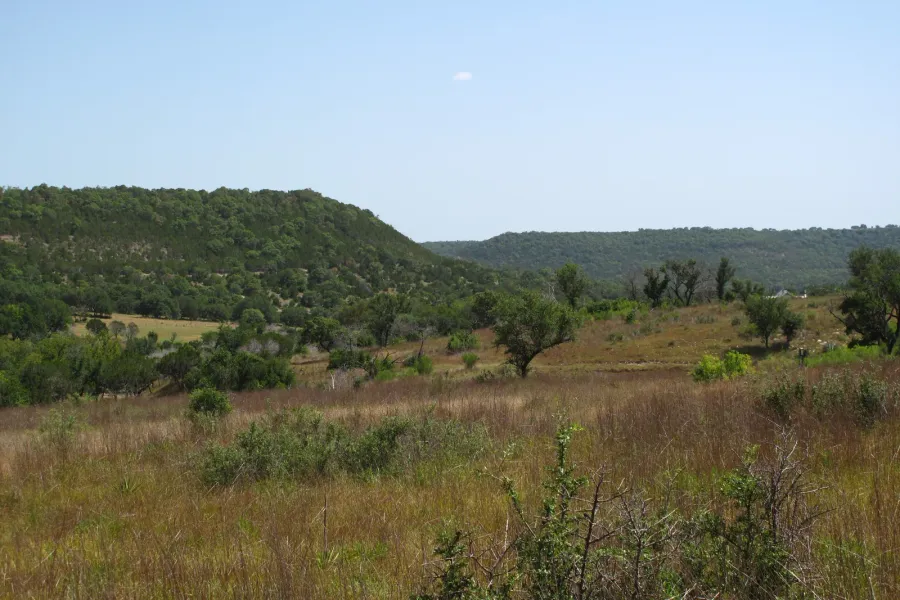
What is the ground like around Austin?
On the plateau side the ground is the Edwards Plateau: shallow soils underlain by limestone, many springs, stony hills and steep canyons. Faulting along the Balcones Fault Zone followed the uplift of that plateau, and streams crossing the zone recharge the aquifer where dissolution has opened the limestone up. For a metal-frame house on a slab that geology shows up twice. The pad, the drainfield trenches and the utility runs can all land in rock, and rock is one of the items a builder prices on the site rather than in the building, along with septic, driveway, power and water. Second, the caves, sinkholes, faults and fractures that make a lot worth looking at are the exact features the recharge zone definition is written around. A lot that is beautiful for the reason limestone country is beautiful is a lot with an aquifer file attached to it.
The other picture is the Blackland Prairies, named for deep, fertile black soils on gently rolling to nearly level land at 300 to 800 feet, with most of the original prairie long since plowed. The behavior that matters for a build is shrink and swell. Houston Black soil, formed in clayey residuum weathered from calcareous mudstone of Upper Cretaceous age on mostly 1 to 3 percent slopes, cracks 0.5 to 4 inches wide from the surface down 12 inches or more when it dries out. That is a soils question for an engineer, not something to settle from a listing photo, and Travis County hands you a deadline for settling it: the first of the three required inspections happens before the concrete is placed.
Two major aquifers run under this part of the state. The Edwards (Balcones Fault Zone) Aquifer is a major aquifer of southcentral Texas, and the Trinity Aquifer extends across much of central and northeastern Texas. If the lot has no utility water, the well question and the septic question arrive together, and in this county they arrive in front of whichever of the seven authorized agents holds your address. Ask that agent what it requires for siting and separation, and ask during the option period, because a local agent may adopt on-site sewage standards stricter than state law or TCEQ rules, and those stricter standards control where they give greater public health and safety protection.
What that changes is the septic evaluation, the foundation and the pad. What it does not change is the process: a soil evaluation on the specific building site decides the septic system, and the slab is engineered for what is under it. The lot guide is the full checklist.
What does a barndominium lot in Travis County run into first?
The same house is or is not an aquifer filing depending on which line the lot falls on. In the contributing zone a plan is triggered once activities disturb at least five acres, or form part of a larger plan of development or sale. On the recharge zone there is no acreage floor at all, and construction cannot begin until the plan is approved.
A lot that straddles two zones does not split the difference. Part contributing and part recharge is treated as recharge and needs the Water Pollution Abatement Plan, and a transition zone site that drains back to the recharge zone escalates the same way. A single-family residence can still stay out of its own plan on a lot larger than five acres as the only residence, or by holding impervious cover to 20 percent or less of the legal property.
The Lake Travis septic zone is stated at two different distances. The river authority's own pages say 2,000 feet, Travis County is reported to say 1,000 feet, and the lower figure was not found in the river authority's own material when these sources were read. If your lot sits between those two lines, get the answer in writing from whichever agent claims it before you site the tank.
Water frontage on Lake Austin or its tributaries puts the property inside Austin Water's septic jurisdiction no matter how the lot, the house or the drainfield are arranged. Setbacks and lot lines do not argue you out of that one.
Your septic agent is set by address, not by county line. The county covers the unincorporated county plus Leander, Manor, San Leanna and Webberville, while Austin, West Lake Hills, Bee Cave, Mustang Ridge, Rollingwood and the river authority each run their own program. Confirm which one claims the lot before you pay anyone to evaluate it.
Above the Regulated Pool Elevation in the Lake Travis watershed, a second permit program sits on top of everything else. A development permit is required if impervious cover will exceed 10,000 square feet and/or land disturbance will exceed one acre, and under both numbers a single-family residence can file a written notification instead.
Which towns and areas does this cover?
Austin is the county seat. Places in and around Travis County include Austin, Lakeway, Bee Cave, Lago Vista, Jonestown, Manor, Pflugerville, Del Valle, Spicewood, Volente. Anywhere in the county outside a city's limits and extraterritorial jurisdiction follows the county's answer above; inside a city, the city's building department applies.
Next on the chain: Williamson County and Bastrop County. Every county's status: do I need a building permit in Central Texas. All six rows with sources: the permit directory.
Questions people ask about Travis County
- Do I need more than the county permit just to clear and grade?
- Possibly two more. On top of the county's own permit, construction disturbing one acre or more, or forming part of a larger common plan that will disturb one acre or more, needs coverage under the state construction stormwater permit TXR150000. If the tract is in the Lake Travis watershed above the Regulated Pool Elevation, the Highland Lakes Watershed Ordinance reaches the same land-disturbing work, with a development permit required once impervious cover exceeds 10,000 square feet and/or disturbance exceeds one acre.
- My tract is over ten acres. Does that exempt my septic system?
- Not here. The state rules do exempt a system serving a single-family dwelling on ten acres or more from planning materials, permit and inspections when every condition is met, but Travis County states no lot-size exemption at all, and the minimum lot for a home on a septic system is one acre. A local agent may adopt standards stricter than the state chapter, and where it does, the stricter standard controls.
- Is the Lake Travis septic zone 2,000 feet or 1,000 feet?
- Both numbers are in circulation and this page does not pretend to resolve it. LCRA's own pages say 2,000 feet for Lake Travis. Travis County is reported to say 1,000 feet, and that lower figure was not found in the river authority's own material when these sources were read. Check the address on the river authority's searchable jurisdiction map, then get the answer in writing from the agent that claims your lot.
- How long does the Edwards Aquifer review take before I can start?
- Administrative review takes up to 30 days and technical review of an administratively complete application takes 90 days, and construction cannot begin until approval issues. On the recharge zone there is no acreage floor, so any regulated activity needs an approved Water Pollution Abatement Plan first. In the contributing zone the plan is triggered at five acres of disturbance or by being part of a larger plan of development or sale.
- Does it matter whether my builder has worked in Travis County before?
- There is no state credential to check. Texas requires no state license for a general contractor, and the commission that once oversaw residential builders was abolished when its Act expired on September 1, 2009, so anyone building for you here is an independent builder. What is checkable is the sequence: the builder, not the county, contracts three inspections, at the foundation before concrete, at framing and mechanical before drywall, and on completion, and the inspector must be one of six qualified persons named in the statute. Ask who they used, on which Travis County jobs, and how recently.
Four fields, no email
Get a free estimate for a build in Travis County
Your county and what you want to build. Free. No obligation. No fee to you at any point.
Tell us where the land is and what you want to build: the pad, the septic, the shell, the finish. Your request goes to one independent builder, and taking the project is their call.