
Does Burnet County require a building permit for a barndominium?
Burnet County does issue building permits outside city limits, and the county will not issue the septic permit without one. There are two classes, set by the flood hazard area. A Class A permit covers a site outside any flood hazard area and is application and payment only, with no county inspection of the structure. A Class B permit covers a site inside a designated flood hazard boundary and needs an elevation certificate from a surveyor or a letter from an engineer, a site plan showing the flood zone, and two inspections, pre-pour and finished construction. The order is fixed and the county will not process an incomplete packet: the 911 address comes first, then the building permit, then the septic permit.
Source: Burnet County On-Site Sewage Facilities and Development Services, read 2026-09-13.
Inside city limits, the city's own building department applies whatever the county does, and a city's extraterritorial jurisdiction can add platting and environmental rules outside its limits. The first question about any lot is which of the three it is in.
Who do I call in Burnet County to confirm?
Burnet County Development Services, 512-715-5260, 133 E. Jackson Street, Room 107, Burnet. Ask whether the county requires a permit for a new single-family home outside city limits and whether it inspects. That call takes five minutes.
Other county permits the official site shows:
- Class A or Class B building permit
- On-site sewage facility (septic) permit, after the building permit
- Floodplain development permit and its two inspections inside a flood hazard area
- County road access permit, signed by the precinct commissioner, before the 911 address
- 911 address, which comes before every other permit
- Plat, unless every lot in the split is over 10 acres with no new streets, and even an exempt split is registered with Development Services
Which lake rules reach my Burnet County lot?
Two separate lake rulebooks can land on the same tract here, and neither one is the county's. The first is septic. The Lower Colorado River Authority is a TCEQ-designated authorized agent for on-site sewage facilities, and its regulated area around the upper Highland Lakes runs 2,200 feet, built from two layers: a restricted zone at each lake, plus a water quality zone extending 2,000 feet horizontally beyond the outer boundary of that restricted zone. Five lakes are named in those rules, and the four upper ones, Buchanan, Inks, Lyndon B. Johnson and Marble Falls, are all Burnet County water. That is why a tract that feels nowhere near a shoreline can still sit inside. The address-searchable jurisdiction map settles it.
The second rulebook is the Highland Lakes Watershed Ordinance, and its scope names this county directly: the Colorado River watershed in Burnet County, above the regulated pool elevation of the Highland Lakes, as drawn on the official ordinance map. It reaches past buildings to roads, paved storage areas and parking lots, and to any land-disturbing and construction activity, including clearing, excavating, grading, contouring, mining and depositing refuse, waste or fill. A development permit is required where impervious cover will exceed 10,000 square feet and/or land disturbance will exceed one acre. Under both of those lines a single-family residence can file a written notification instead. Over 10,000 square feet of impervious cover but still under an acre disturbed, the notification route stays open only if the site meets the downstream buffer guidelines in the technical manual. Eleven local governments administer part or all of the ordinance under interlocal agreements, so the office that applies may not be the river authority at all.
The river authority is a septic agent in only three of the six counties on this site: Travis, Burnet and Llano. Llano County sits under the same lakes and the same zone rules, and issues no building permit of its own. Williamson County has one septic agent for the whole county and no river authority in it anywhere, which is why advice carried over from there does not fit a lake lot. Reading a shoreline tract is covered in the Highland Lakes lot guide, and putting the calls in order is most of what lot evaluation does.
Run the address through the river authority's OSSF and watershed jurisdiction map. It answers the septic-agent question and the watershed question in one lookup.
Ask whoever administers the ordinance at that address, which may not be the river authority, whether the tract is above the regulated pool elevation and inside the ordinance map.
Count impervious cover early. A barndominium site carries the house slab, a shop apron, a driveway and parking, and all of it counts toward the 10,000 square foot line.
Source: TCEQ OARS county search, identical entry returned for Travis, Burnet and Llano counties, read 2026-09-13.
Source: LCRA On-Site Sewage Facilities Program, read 2026-09-13.
Source: LCRA On-Site Sewage Facilities Rules, Section 6, Area of Jurisdiction, read 2026-09-13.
Source: LCRA Water Quality Jurisdictions map, read 2026-09-13.
Source: LCRA Highland Lakes Watershed Ordinance, Section 1, Title and Scope, read 2026-09-13.
Source: LCRA Highland Lakes Watershed Ordinance program page, read 2026-09-13.
Source: LCRA Highland Lakes Watershed Ordinance program page, Required notifications and permits, read 2026-09-13.
Source: LCRA Highland Lakes Watershed Ordinance, Section 4.1(b), Written Notification, read 2026-09-13.
Source: LCRA Highland Lakes Watershed Ordinance program page, Interlocal agreements, read 2026-09-13.
Source: TCEQ OARS county search, Williamson County (CNTY_CD 246), read 2026-09-13.
Source: Burnet County On-Site Sewage Facilities and Development Services, read 2026-09-13.
Source: Llano County Development Services, read 2026-09-13.
Source: Williamson County frequently asked questions, County Engineer, read 2026-09-13.
Why does Burnet have eight septic agents when its neighbors have one or two?
Eight authorized agents permit on-site sewage in Burnet County: the county, the Lower Colorado River Authority, and six city agents, Cottonwood Shores, Bertram, Burnet, Granite Shoals, Marble Falls and Horseshoe Bay. Granite Shoals is administered by the river authority and Bertram by the county, so two of those names do not decide their own files. Nothing else on this site is close. Williamson has a single agent for the entire county. Bastrop has two, Llano three, Caldwell five, Travis seven. The result is that in Burnet, who permits your septic is a live question with a real answer, and the answer is set by the address rather than by which office you happen to call first.
What changes with the answer is more than a letterhead. A local authorized agent may adopt on-site sewage standards stricter than state law or TCEQ rules, and where they are stricter, they control. Timelines change too. Inside the river authority's jurisdiction a permit is required before constructing or installing any system no matter the lot size, and you are told to allow up to 30 days from the date the application is submitted, before any design or site complications. Separately, a permitting authority must approve or deny planning materials and the permit application within 30 days of receipt, with a written explanation on denial and an appeal to its supervisory body. One thing the published pages do not answer, so put it to Development Services directly: when the river authority is your septic agent instead of the county, does the river authority's review window start before or after the county building permit issues? That answer decides whether two 30-day windows run side by side or back to back, which is the difference between a month and two months at the front of the job.
Two river-authority rules catch owners later rather than at permitting, and both are easy to miss on a lake tract. An inspection is required on every transfer of ownership before continued use is approved, which matters when you buy a tract that already has a system and again on the day you sell. And an aerobic treatment unit needs a maintenance contract for the first two years; after that the owner may do the maintenance, but only after taking the class and passing the test. The full process is in the Central Texas septic permit guide.
The state's authorized agent lookup is a county search that returns every agent in the county and the area each one serves. Run it once and keep the result with the lot file.
Only a licensed or registered installer may build the system. Installer I covers standard systems and Installer II covers all system types, and both are verifiable in TCEQ's public license lookup.
If an aerobic unit is likely, price the two-year maintenance contract into the build rather than meeting it in year one.
Source: TCEQ OARS county search, Burnet County (CNTY_CD 27), read 2026-09-13.
Source: TCEQ OARS county search, Williamson County (CNTY_CD 246), read 2026-09-13.
Source: TCEQ OARS county search, Bastrop County (CNTY_CD 11), read 2026-09-13.
Source: TCEQ OARS county search, Llano County (CNTY_CD 150), read 2026-09-13.
Source: TCEQ OARS county search, Caldwell County (CNTY_CD 28), read 2026-09-13.
Source: TCEQ OARS county search, Travis County (CNTY_CD 227), read 2026-09-13.
Source: TCEQ OARS county search, identical entry returned for Travis, Burnet and Llano counties, read 2026-09-13.
Source: Texas Health and Safety Code Sec. 366.032(b), read 2026-09-13.
Source: LCRA On-Site Sewage Facilities Rules, Section 10.05(b), read 2026-09-13.
Source: LCRA On-site Sewage Rules Frequently Asked Questions, read 2026-09-13.
Source: TCEQ, Getting a Permit for an On-Site Sewage Facility, read 2026-09-13.
Source: TCEQ On-Site Activity Reporting System, search by county, read 2026-09-13.
Source: TCEQ, Occupational Licenses: On-Site Sewage Facilities (Septic Systems), read 2026-09-13.
Source: TCEQ, On-site Sewage Facilities: Information for Regulators, read 2026-09-13.
Source: Burnet County On-Site Sewage Facilities and Development Services, read 2026-09-13.
What is under a Burnet County tract, and what does a well hit?
Burnet is one of the core counties of the Llano Uplift, a large granite batholith and the major structural feature of central Texas, with Precambrian granites and metamorphic rocks forming the central dome. At Inks Lake State Park, on the east edge of the uplift, pink Valley Spring gneiss juts up through the limestone, which is the rock boundary showing itself at the surface. What that means for a budget is simple: excavation, the pad, the drainfield and the utility runs are priced on the site itself, outside the per-square-foot figure a builder quotes for the building, so rock found late is a change order rather than a rounding error. Access work is priced the same way, and culverts and crossings are covered in the ranch roads and culverts guide.
The water under the tract is its own question. The Ellenburger-San Saba is a minor aquifer in parts of 16 counties in the Llano Uplift area. The Hickory is a minor aquifer made from the water-bearing parts of the Hickory Sandstone Member, and it carries radionuclides derived from the Precambrian granite of the uplift. The Trinity is a major aquifer reaching across much of central and northeastern Texas. Nothing published here tells you which one a particular Burnet tract draws from, so the driller answers that, along with what the well produces and what the water tests at. One aquifer question this county does not have: the Edwards Aquifer Protection Program covers eight Texas counties and Burnet is not one of them.
If any part of the tract sits inside a mapped flood hazard boundary, line the elevation certificate up early rather than late. Elevation information on that certificate is certified by land surveyors, architects and engineers authorized by law, and their calendars usually set the date. The same certificate does work long after the slab: it is the NFIP tool used to set the flood insurance premium rate, to document compliance with the community's floodplain rules, and to support a map amendment or revision request later.
Ask for test holes during the option period, in the house pad and again where the drainfield is going. Those are the two places the rock decides the price.
Ask the driller what nearby wells produce and what they test at, including for radionuclides, before the option period closes.
The golden-cheeked warbler nests and breeds only in mixed Ashe juniper and deciduous woodlands of central Texas, arriving from January to March and leaving in late summer. If juniper clearing is in the plan, ask Texas Parks and Wildlife whether your tract is mapped habitat before the saws start.
Source: Texas Water Development Board, Report 360 Chapter 9, Paleozoic Aquifers of the Llano Uplift, read 2026-09-13.
Source: Texas Water Development Board, Report 360 Chapter 9, read 2026-09-13.
Source: Texas Parks and Wildlife Department, read 2026-09-13.
Source: Texas Water Development Board, read 2026-09-13.
Source: Texas Water Development Board, read 2026-09-13.
Source: Texas Water Development Board, read 2026-09-13.
Source: TCEQ GIS metadata, Edwards Aquifer Recharge Zone - Chapter 213 Rules (TSMS), quoting 30 TAC 213.3(8), read 2026-09-13.
Source: FEMA, Elevation Certificate FAQ, October 2023, read 2026-09-13.
Source: FEMA 467-1, Floodplain Management Bulletin: Elevation Certificate, read 2026-09-13.
Source: U.S. Fish and Wildlife Service, read 2026-09-13.
Source: Burnet County On-Site Sewage Facilities and Development Services, read 2026-09-13.
Does it matter whether my lot is inside a city?
It matters more here than on most of this chain, because six city agents appear in Burnet County alongside the county and the river authority: Cottonwood Shores, Bertram, Burnet, Granite Shoals, Marble Falls and Horseshoe Bay. Two of those cities have their building rules on record, and they do not match. Inside Marble Falls a building permit is required for all construction, new construction is on the city's published list of work requiring one, and the city has adopted the 2024 International Residential Code with the 2023 National Electric Code. Step one mile out into that city's ETJ and Marble Falls regulates signs, subdivision of land, non-point source pollution and water quality, and issues no building, electrical or mechanical permit at all. Two lots with the same lake view can sit on opposite sides of that line.
Inside the city of Burnet a permit is required for any construction that physically changes or adds a structure, with dwellings first on the list, and the city adopted the 2021 International Codes including the 2021 IRC, plus the 2021 Fire Code and the 2023 National Electrical Code, effective for new permits received on or after April 1, 2025. That effective date runs against the date the permit is received, not the date the plans were drawn, which is worth knowing on a project that has been sitting.
The city line also moves the septic answer, because each of those six cities appears as its own authorized agent and an address inside one is not automatically a county file. Settle jurisdiction before design starts. A plan drawn to county expectations can need rework to clear an adopted code year, and that rework lands on whichever independent builder is doing the barndominium build. Texas licenses no home builder or general contractor, so that word is independent, not licensed.
Ask which code edition applies on the date your permit is received, not the edition in force when the plans were drawn. In the city of Burnet that distinction is written into the adoption.
A lot in the Marble Falls ETJ is not a lot with no rules. The city still regulates signs, subdivision, non-point source pollution and water quality there, and county rules still apply underneath.
If the address reads Cottonwood Shores, Bertram, Burnet, Granite Shoals, Marble Falls or Horseshoe Bay, confirm the septic agent before assuming the county has your file.
Source: City of Marble Falls FAQ, Do I need a permit within the city limit?, read 2026-09-13.
Source: City of Marble Falls Building Division, read 2026-09-13.
Source: City of Marble Falls FAQ, Do I need a permit outside the city limit?, read 2026-09-13.
Source: City of Burnet Building Department, read 2026-09-13.
Source: City of Burnet, Burnet Code Adoption 2021 (PDF, city-hosted), read 2026-09-13.
Source: TCEQ OARS county search, Burnet County (CNTY_CD 27), read 2026-09-13.
Source: Office of the Texas Governor, Business Permit Office, Texas Business Licenses and Permits Guide, read 2026-09-13.
Source: Burnet County On-Site Sewage Facilities and Development Services, read 2026-09-13.
If the county does not inspect the structure, who does?
On a site outside a flood hazard boundary, nobody does unless you arrange it, and that is worth planning around instead of discovering. State law does not fill the gap either. Texas does not require a state license to work as a general contractor, and the Texas Residential Construction Commission was abolished with its enabling Act expiring on September 1, 2009. The county residential building code standards the Local Government Code makes available are opt-in, applying only where a county has first adopted a resolution or order and meets the border or population condition, and that subchapter creates no zoning power and no authority to require permission before construction starts.
So the licensed people on your job are a short list, and your builder is not on it. Electricians are licensed by TDLR, and non-exempt electrical work must be done through a licensed electrical contractor. Plumbers are licensed by the state through the Texas State Board of Plumbing Examiners. OSSF installers are licensed or registered by TCEQ. All three have public lookups. A builder in Texas is an independent builder, and that is a statement about state law, not about the builder.
What replaces county inspection is what you put in the contract. Where the opt-in county standards do run, the pattern is three inspections: foundation before concrete is placed, framing and mechanical before drywall, and on completion, contracted by the builder from a list of six qualified persons, with one inspector throughout or a different one each time. Nothing stops you buying that same sequence privately on a site nobody will inspect, and nothing stops you tying draw payments to it. How the six counties differ on all of this is in the permit guide.
Verify the electrician at the TDLR license search, the plumber at the TSBPE lookup and the septic installer at the TCEQ license lookup. Do it before work starts, not after a failure.
Write the three inspection points into the contract as payment milestones, with the inspector named and paid by you.
An owner-builder building their own primary residence, or acting as their own contractor on it, is not penalized for failing to give the statutory notices, which is worth raising with a lender before deciding how to structure the build.
Source: Office of the Texas Governor, Business Permit Office, Texas Business Licenses and Permits Guide, read 2026-09-13.
Source: Texas Sunset Advisory Commission, read 2026-09-13.
Source: Texas Local Government Code Sec. 233.152, read 2026-09-13.
Source: Texas Local Government Code Sec. 233.154(a)(1), read 2026-09-13.
Source: Texas Local Government Code Sec. 233.154(a)(3), read 2026-09-13.
Source: Texas Local Government Code Sec. 233.153(d), read 2026-09-13.
Source: Texas Local Government Code Sec. 233.157(c), read 2026-09-13.
Source: Texas Department of Licensing and Regulation, Electricians program, read 2026-09-13.
Source: Texas Department of Licensing and Regulation, read 2026-09-13.
Source: Texas State Board of Plumbing Examiners, read 2026-09-13.
Source: Texas State Board of Plumbing Examiners, read 2026-09-13.
Source: TCEQ, Occupational Licenses: On-Site Sewage Facilities (Septic Systems), read 2026-09-13.
Source: TCEQ, On-site Sewage Facilities: Information for Regulators, read 2026-09-13.
Source: Burnet County On-Site Sewage Facilities and Development Services, read 2026-09-13.
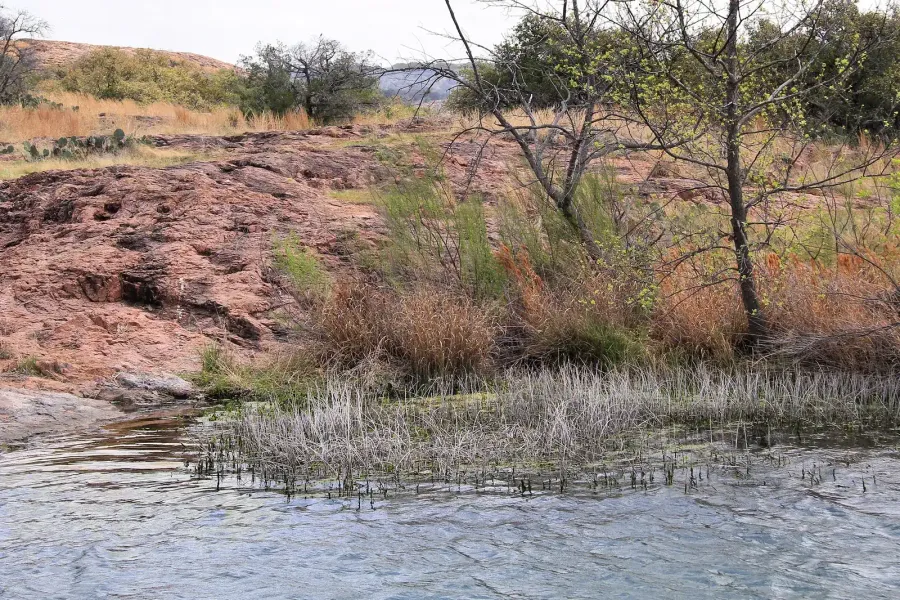
What is the ground like around Burnet?
Burnet is one of the core counties of the Llano Uplift, a large granite batholith and the major structural feature of central Texas, with Precambrian granites and metamorphic rocks forming the central dome. At Inks Lake State Park, on the east edge of the uplift, pink Valley Spring gneiss juts up through the limestone. That is the county's ground problem standing in plain view: hard igneous and metamorphic rock on one side of a boundary, limestone on the other, and nothing at the road that tells you which is under a given tract. Neither one gives you an easy trench, and the trench you notice first is usually the drainfield.
Well water is a separate question from lake water here, and the county sits in the part of the state where the minor aquifers of the Llano Uplift area turn up. The Ellenburger-San Saba is a minor aquifer in parts of 16 counties in that area. The Hickory is a minor aquifer made from the water-bearing parts of the Hickory Sandstone Member, and it carries radionuclides derived from the Precambrian granite of the uplift. The Trinity is a major aquifer reaching across much of central and northeastern Texas. Which one a well on your tract lands in, what it produces and what it tests at are questions for the driller before you buy, not after.
What that changes is the septic evaluation, the foundation and the pad. What it does not change is the process: a soil evaluation on the specific building site decides the septic system, and the slab is engineered for what is under it. The lot guide is the full checklist.
What does a barndominium lot in Burnet County run into first?
Burnet is not one of the eight counties in the Edwards Aquifer Protection Program. A plan or a checklist that traveled here from a Williamson or Travis lot carries an aquifer step this county does not have, and leaves out the two water rules that do reach it.
Eight offices permit septic in this county, more than any of the other five on this site, and Granite Shoals runs through the river authority while Bertram runs through the county. The town on the mailing address does not tell you who holds the file.
The river authority's septic jurisdiction reaches further inland than buyers expect: 2,200 feet around the upper Highland Lakes, built as a restricted zone at each lake plus a water quality zone running another 2,000 feet horizontally beyond that zone's outer boundary. All four upper lakes named in those rules are Burnet County water.
Clearing counts as regulated activity under the Highland Lakes Watershed Ordinance, alongside excavating, grading, contouring and depositing fill, and the ordinance names the Colorado River watershed in Burnet County above the regulated pool elevation. Land disturbance over one acre, or impervious cover over 10,000 square feet, moves a single-family site off the written notification route.
Two cities here enforce different code editions. Marble Falls is on the 2024 International Residential Code inside the limits, and one mile out it issues no building, electrical or mechanical permit at all. The city of Burnet is on the 2021 International Residential Code, effective for new permits received on or after April 1, 2025.
Rock on both halves of the county, granite and gneiss on the uplift side and limestone where the gneiss pushes through it. Ask for test holes in the pad and the drainfield area during the option period rather than budgeting excavation from a square-foot figure.
Which towns and areas does this cover?
Burnet is the county seat. Places in and around Burnet County include Burnet, Marble Falls, Bertram, Granite Shoals, Cottonwood Shores, Meadowlakes, Highland Haven, Briggs. Town pages: Burnet, Marble Falls. Anywhere in the county outside a city's limits and extraterritorial jurisdiction follows the county's answer above; inside a city, the city's building department applies.
Next on the chain: Llano County and Williamson County. Every county's status: do I need a building permit in Central Texas. All six rows with sources: the permit directory.
Questions people ask about Burnet County
- Can I use the state's ten-acre septic exemption on a big tract in Burnet County?
- No. The state rule at 30 TAC 285.3 exempts a single family dwelling's system on ten acres or more from planning materials, permit and inspections, but only if every condition is met, including keeping all parts at least 100 feet from the property line and disposing of effluent on the property. Burnet County permits and inspects every on-site system whatever the tract size, which sets the state exception aside, and inside the river authority's jurisdiction a permit is required before constructing or installing any system no matter the lot size.
- How do I find out whether the county or the river authority permits my septic?
- By address. Eight authorized agents operate in this county: Burnet County, the Lower Colorado River Authority, Cottonwood Shores, Bertram, Burnet, Granite Shoals, Marble Falls and Horseshoe Bay, with Granite Shoals administered by the river authority and Bertram by the county. Run the address through the river authority's OSSF and watershed jurisdiction map, and run the county through TCEQ's authorized agent search, which returns every agent and the area each one serves. The county publishes a link to that jurisdiction map and does not say which lake lots fall inside it, so the lookup is the answer, not the assumption.
- Do I need an Edwards Aquifer plan for a barndominium in Burnet County?
- No. The Edwards Aquifer Protection Program covers eight Texas counties and Burnet is not one of them. The water quality rules that do reach lots here are different ones: the river authority's septic jurisdiction around the upper Highland Lakes, and the Highland Lakes Watershed Ordinance, whose scope names the Colorado River watershed in Burnet County above the regulated pool elevation. Do not let a plan drawn for a county east or south of here import an aquifer step that does not apply, or skip the watershed step that does.
- Is my barndominium builder licensed?
- No builder in Texas is. The state does not require a license to work as a general contractor, and the Texas Residential Construction Commission was abolished with its enabling Act expiring on September 1, 2009. Local city or county requirements can still apply. The licensed trades on a Burnet County job are the septic installer, licensed or registered by TCEQ, the electrician, licensed by TDLR with non-exempt work done through a licensed electrical contractor, and the plumber, licensed by the Texas State Board of Plumbing Examiners. All three have public license lookups. Anyone described that way is being described as something that does not exist in this state.
- How much of the price of a Burnet County build is the lot rather than the building?
- More than most buyers expect, and this is the county where it shows. A per-square-foot number covers the building and stops there. Septic, driveway, power, water, rock and the pad are all priced on the site itself, and in a county whose rock runs from granite and gneiss into limestone, the excavation line is the one that moves. The cost guide carries the one builder figure this site publishes, with its date, and says plainly that it is not a market rate.
Four fields, no email
Get a free estimate for a build in Burnet County
Your county and what you want to build. Free. No obligation. No fee to you at any point.
Tell us where the land is and what you want to build: the pad, the septic, the shell, the finish. Your request goes to one independent builder, and taking the project is their call.