
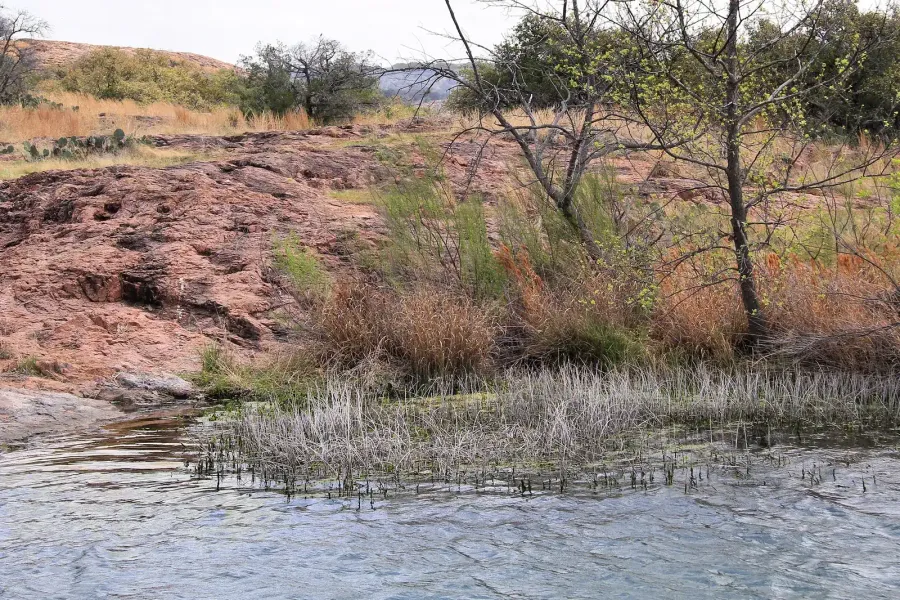
What is a stock tank, and how is it different from a pond?
On a Texas lot the two words get used for the same thing. A stock tank is a pond that fills with rain running off the ground above it, built to water livestock and still called a tank whether or not a cow ever drinks from it.
There are two ways to build one, and the questions split there. You can dig a pit in a low spot off any drainage. Or you can dam a draw and let the watershed above it fill the pond. Ask the state in writing whether that choice changes the water right answer, and ask who reviews the embankment on a dammed tank. Decide which one you are building first, because the offices will want to know.
Will your soil hold water, or will the pond drain away?
Test holes answer that, not a map. What sits under the topsoil at the tank location decides it, and the ground changes across these counties.
The Blackland Prairies region is named for its deep, fertile black soils, gently rolling to nearly level at 300 to 800 feet. The Post Oak Savannah is a transitional region of oak woodland and grassland at the same elevations, with sands and sandy loams in the uplands, clay or clay loams in the bottomlands, and a dense clay pan almost impervious to water under all soil types at only a few feet deep. A layer water cannot get through is what a dug tank needs under it, so ask your excavator whether that pan sits under your spot and how deep it runs.
Clay brings its own question. Houston Black soil formed in clayey residuum weathered from calcareous mudstone of Upper Cretaceous age, and it cracks 0.5 to 4 inches wide from the surface down 12 inches or more when it dries. Ask what that does to a tank bottom in a dry summer.
Rock changes the job. The Edwards Plateau has shallow soils underlain by limestone, many springs, stony hills and steep canyons, and along the Balcones Fault Zone streams crossing the zone recharge the aquifer where permeability is enhanced by dissolution of limestone. Ask what a dissolution channel under the tank site would do to standing water. Burnet and Llano are Llano Uplift counties, and the uplift is a large granite batholith with Precambrian granites and metamorphic rocks forming the central dome. At Inks Lake State Park in Burnet County, pink Valley Spring gneiss juts up through the limestone. There the working question is how deep a machine gets before rock. Settle it in a land and lot evaluation, before the offer.
Source: Texas Parks and Wildlife Department, Texas Ecoregions, read 2026-09-13.
Source: USDA NRCS, Official Series Description, Houston Black Series, read 2026-09-13.
Source: Texas Parks and Wildlife Department, read 2026-09-13.
Source: USGS, Karst Aquifers: Edwards Balcones Fault Zone Aquifer, read 2026-09-13.
Source: Texas Water Development Board, Report 360 Chapter 9, Paleozoic Aquifers of the Llano Uplift, read 2026-09-13.
Source: Texas Water Development Board, Report 360 Chapter 9, read 2026-09-13.
Source: Texas Parks and Wildlife Department, read 2026-09-13.
Does a stock tank or pond need a water right in Texas?
Ask the state in writing before the dirt work is bid. This page cannot answer it, a builder cannot answer it, and a neighbor cannot answer it. Ask your county development office where to send the question when you file for the development permit, then ask precisely and keep the written reply with the deed and the plat. Does this pond need a water right? Does the answer change if it sits on a draw that carries flow after rain rather than in a pit off any drainage? Does it change with the size of the pond, or the size of the watershed feeding it? Is there an exemption, and what conditions ride with it?
You will hear numbers on this. Someone will tell you a pond under a certain size is fine. Do not build on a number you heard. A written answer from the state is the only one that still holds after the tank is full.
Which office answers the floodplain question, and which answers the dam question?
The floodplain question goes to your county floodplain administrator, the official responsible for making sure development complies with floodplain management regulations and other applicable codes, and that permits are applied for. A permit is required before construction or development begins inside any Special Flood Hazard Area. The dam question is a state question and this page cannot name the office that takes it, so ask your county development office where to send it.
Start the check yourself at the FEMA Flood Map Service Center, the official public source for flood hazard information produced for the National Flood Insurance Program, searchable by address, place name or coordinates. If the lot is in, an Elevation Certificate enters the job: it is the NFIP tool used to set the flood insurance premium rate and to document elevation for compliance with community floodplain management regulations, and land surveyors, architects and engineers authorized by law certify the elevation information on it.
Travis County TNR: site plans, lowest floor elevations, a flood venting plan, an elevation certificate before framing starts and a finished construction certificate within 30 days.
Williamson County Engineer's Office: a floodplain development permit in or next to the 100-year floodplain, the structure at least a foot above base flood elevation, and a FEMA elevation certificate after the slab and at completion.
Burnet County Development Services: one foot of freeboard above base flood elevation required, two recommended in an A zone. Inside a flood hazard boundary it is a Class B permit, an elevation certificate and two inspections.
Bastrop County Development Services: two feet of freeboard, extended to some Zone X areas where base level engineering has set flood depths.
Caldwell County, where the Director of Sanitation is the Floodplain Administrator: a permit for all construction in the mapped flood zones, and a home inside or within 300 feet of a floodplain sets its first finished floor at least two feet above the adjoining base flood elevation.
Llano County Development Services: a floodplain development permit for any development in a special flood hazard area, on a review longer than the county's usual seven to 10 business days.
Source: FEMA glossary, Permit for Floodplain Development, read 2026-09-13.
Source: FEMA, NFIP Floodplain Management Requirements study guide, Unit 7, read 2026-09-13.
Source: FEMA Flood Map Service Center, read 2026-09-13.
Source: FEMA 467-1, Floodplain Management Bulletin: Elevation Certificate, read 2026-09-13.
Source: FEMA, Elevation Certificate FAQ, October 2023, read 2026-09-13.
Source: Travis County Transportation and Natural Resources, Development Services, read 2026-09-13.
Source: Williamson County frequently asked questions, County Engineer, read 2026-09-13.
Source: Burnet County On-Site Sewage Facilities and Development Services, read 2026-09-13.
Source: Bastrop County Development Services, read 2026-09-13.
Source: Caldwell County Development Ordinance, revised February 14, 2023, read 2026-09-13.
Source: Llano County Development Services, read 2026-09-13.
Do you need a permit to dig a stock tank in the Highland Lakes watershed?
Maybe, and the trigger is how much ground you disturb, not how big the pond is. The Highland Lakes Watershed Ordinance regulates construction of buildings, roads, paved storage areas and parking lots, plus any land disturbing and construction activity including clearing, excavating, grading, contouring, mining and depositing refuse, waste or fill. Digging a tank and spreading the spoil is on that list by name.
It covers the Lake Travis watershed in Travis County, the Colorado River watershed in Burnet County and a portion of Llano County, above the Regulated Pool Elevation of the Highland Lakes, as drawn on the official Ordinance Map. An LCRA development permit is required if impervious cover will exceed 10,000 square feet and/or land disturbance will exceed one acre. A single family residence can instead file a written notification with LCRA when it creates under 10,000 square feet of impervious cover and disturbs under one acre. Above 10,000 square feet of impervious cover but still under an acre disturbed, that route stays open only if the site meets the downstream buffer guidelines in the LCRA Technical Manual.
Ask LCRA whether the pad, the driveway, the septic field and the tank count as one disturbance figure before you assume you are under an acre. That acre matters again for stormwater: the TPDES Construction General Permit TXR150000 covers construction disturbing one acre or more, or part of a larger common plan of development that will, and below one acre no coverage is required. Ask who administers the ordinance on your tract, too, because eleven local governments administer part or all of it under interlocal agreements.
Travis County adds a layer. Any development in Travis County requires a permit, and the county defines development to include mining, dredging, filling, grading, paving, excavation and clearing land to prepare a site. A tank is development there in the county's own words.
Source: LCRA Highland Lakes Watershed Ordinance program page, read 2026-09-13.
Source: LCRA Highland Lakes Watershed Ordinance, Section 1, Title and Scope, read 2026-09-13.
Source: LCRA Highland Lakes Watershed Ordinance program page, Required notifications and permits, read 2026-09-13.
Source: LCRA Highland Lakes Watershed Ordinance, Section 4.1(b), Written Notification, read 2026-09-13.
Source: LCRA Highland Lakes Watershed Ordinance program page, Interlocal agreements, read 2026-09-13.
Source: TCEQ, Stormwater Discharges from Construction Activities: Am I Regulated?, read 2026-09-13.
Source: Travis County Transportation and Natural Resources, Development Services, read 2026-09-13.
How does the Edwards Aquifer program change the answer in Travis and Williamson?
Earthwork on a Travis or Williamson tract can need a TCEQ plan approved before construction starts. Both counties sit in the Edwards Aquifer Protection Program, handled by the TCEQ Austin Regional Office at (512) 339-2929, and in Travis County the aquifer plan question comes before site work on the western side of the county. Find the parcel on the TCEQ Edwards Aquifer Map Viewer and print the map.
In the contributing zone, the watershed upgradient of the recharge zone, a Contributing Zone Plan is triggered when activities disturb at least five acres or are part of a larger plan of development or sale, and below that no Edwards Aquifer protection plan is needed. On the recharge zone, where the aquifer's rock units crop out, there is no acreage floor: any regulated activity needs an approved Water Pollution Abatement Plan first, and a site sitting partly on each is treated wholly as recharge zone. Administrative review takes up to 30 days and technical review of a complete application takes 90 days. Ask the regional office whether a tank and its spoil change the answer for your lot.
Source: TCEQ Edwards Aquifer Protection Program home page, read 2026-09-13.
Source: TCEQ GIS metadata, quoting 30 TAC 213.3(25), read 2026-09-13.
Source: TCEQ GIS metadata, quoting 30 TAC 213.22(2), read 2026-09-13.
Source: TCEQ, Contributing Zone Plan page, read 2026-09-13.
Source: TCEQ, Edwards Aquifer Protection Program: What Plans You Might Need, read 2026-09-13.
Source: TCEQ, Water Pollution Abatement Plan page, read 2026-09-13.
Source: TCEQ, What Plans You Might Need, recharge zone branch, read 2026-09-13.
Source: TCEQ, What Plans You Might Need, contributing zone branch, read 2026-09-13.
Source: TCEQ, Edwards Aquifer Map Viewer page, read 2026-09-13.
Source: Travis County Transportation and Natural Resources, Development Services, read 2026-09-13.
How close can the septic drainfield sit to the water?
That is a site evaluation question, and the office that answers it is your county's septic program, or LCRA near the lakes. Ask before the tank is placed on the plan, because a drainfield is harder to move than a pond.
An OSSF permit is required to construct, install, alter, extend or repair a septic system. A local authorized agent may adopt standards stricter than state law or TCEQ rules, and the stricter local standard controls where it gives greater public health and safety protection, so the binding setback is the local one and you have to ask for it by name. Find who holds it with TCEQ's authorized agent county search in the On-Site Activity Reporting System, which returns every agent in the county and the area each serves. Travis County has seven agents, Burnet eight, Caldwell five, Llano three, Bastrop two, and Williamson one covering the whole county.
Near the lakes, LCRA is one of those agents. It regulates on site sewage facilities within a 2,200 foot zone around the upper Highland Lakes and a 2,000 foot zone around Lake Travis, built as a Restricted Zone at each lake plus a Water Quality Zone reaching 2,000 feet horizontally beyond that zone's outer boundary. A permit is required there before any system is constructed, whatever the lot size, and LCRA asks up to 30 days for a new system permit. One conflict is on record and unresolved: LCRA's own pages say the Lake Travis zone is 2,000 feet, while Travis County is reported to say 1,000 feet. Confirm with both offices rather than picking one, and check your address on LCRA's searchable OSSF and watershed jurisdiction map.
Do not count on the state acreage exemption. Travis, Bastrop, Caldwell, Burnet and Llano counties each permit every system whatever the tract size, which sets aside the 30 TAC 285.3 exemption for a single dwelling on ten acres or more. The permitting authority must approve or deny within 30 days of receipt, with a written explanation on denial.
How close may the drainfield, the tank and any spray area sit to a pond, a creek or the lake?
Does adding a tank move the drainfield the site evaluation already approved?
Does a dug pond count as surface water for the setback, or only a natural watercourse?
Source: TCEQ, Getting a Permit for an On-Site Sewage Facility, read 2026-09-13.
Source: Texas Health and Safety Code Sec. 366.032(b), read 2026-09-13.
Source: TCEQ publication RG-472, On-Site Sewage Facility Rules Compilation, 30 TAC 285.10(b)(4), read 2026-09-13.
Source: TCEQ On-Site Activity Reporting System, search by county, read 2026-09-13.
Source: TCEQ OARS county search, Travis County (CNTY_CD 227), read 2026-09-13.
Source: TCEQ OARS county search, Williamson County (CNTY_CD 246), read 2026-09-13.
Source: TCEQ OARS county search, Burnet County (CNTY_CD 27), read 2026-09-13.
Source: TCEQ OARS county search, Llano County (CNTY_CD 150), read 2026-09-13.
Source: TCEQ OARS county search, Bastrop County (CNTY_CD 11), read 2026-09-13.
Source: TCEQ OARS county search, Caldwell County (CNTY_CD 28), read 2026-09-13.
Source: TCEQ OARS county search, identical entry returned for Travis, Burnet and Llano counties, read 2026-09-13.
Source: LCRA On-Site Sewage Facilities Program, read 2026-09-13.
Source: LCRA On-Site Sewage Facilities Rules, Section 6, Area of Jurisdiction, read 2026-09-13.
Source: LCRA On-Site Sewage Facilities Rules, Section 10.05(b), read 2026-09-13.
Source: LCRA Water Quality Jurisdictions map, read 2026-09-13.
Source: TCEQ adopted rule text, 30 TAC Chapter 285, Rule Project No. 2021-030-285-CE, section 285.3, read 2026-09-13.
Source: LCRA On-site Sewage Rules Frequently Asked Questions, read 2026-09-13.
Source: Travis County Transportation and Natural Resources, Development Services, read 2026-09-13.
Source: Bastrop County Development Services, read 2026-09-13.
Source: Caldwell County Development Ordinance, revised February 14, 2023, read 2026-09-13.
Source: Burnet County On-Site Sewage Facilities and Development Services, read 2026-09-13.
Source: Llano County Development Services, read 2026-09-13.
Where does the tank fall in the order of work?
Behind the paperwork. Several of these counties fix the order the permits come in, and the tank fits around that order, not the other way around.
Two site plan details get missed. The spoil from a tank is fill, and depositing fill is named in the watershed ordinance as a land disturbing activity, so decide where it lands before the machine starts and keep it out of any mapped Special Flood Hazard Area, where a permit is required before development begins. Then ask the site evaluator which way the tank should drain in relation to the drainfield and the pad, before either is fixed on the plan.
The rest of the sequence is in the guide to building a barndominium in Central Texas. Ask the independent builder quoting your barndominium construction whether the pad, the driveway and the tank can go in on one dirt mobilization, and who carries the permit for each.
Burnet County: the 911 address first, then the building permit, then the septic permit. Driveway approval must be in hand before the 911 address is assigned, and the county will not process an incomplete packet.
Bastrop County: the development permit, septic permit, driveway and 911 address go on one application, and the permit class is set by the parcel's relationship to the mapped 100-year floodplain.
Caldwell County: the Residential Construction Permit needs the recorded plat or a metes and bounds survey, the deed, tax certificates showing current taxes paid, a sketch of the structure, the approved 911 address and the approved septic permit.
Williamson County: a Certificate of Compliance from the County Engineer comes before construction and before the septic application, and septic applications go through the county's online portal only.
Llano County: a development permit, which is also the 911 address application, with seven to 10 business days asked for outside the floodplain and longer inside it.
Source: LCRA Highland Lakes Watershed Ordinance program page, read 2026-09-13.
Source: FEMA glossary, Permit for Floodplain Development, read 2026-09-13.
Source: Burnet County On-Site Sewage Facilities and Development Services, read 2026-09-13.
Source: Bastrop County Development Services, read 2026-09-13.
Source: Caldwell County Development Ordinance, revised February 14, 2023, read 2026-09-13.
Source: Williamson County frequently asked questions, County Engineer, read 2026-09-13.
Source: Llano County Development Services, read 2026-09-13.
What should you ask before you dig?
Take this list to the offices by name, and get the answers before the machine is scheduled.
The state, in writing: does this impoundment need a water right, is there an exemption, and which office reviews the embankment? Ask your county development office where to send it.
Your county floodplain administrator: is the tank, the spoil pile or the pad in a mapped Special Flood Hazard Area, and what does the permit require? Check the FEMA Flood Map Service Center first.
Your county septic office, or LCRA inside its zones: what setback applies between the drainfield and open water, and does the tank move the approved field?
LCRA, on a Travis, Burnet or Llano tract in the watershed: does the total disturbance trip the permit at 10,000 square feet of impervious cover or one acre, or does written notification cover it? Which of the eleven local governments administers the ordinance here?
TCEQ Austin Regional Office, (512) 339-2929, for a Travis or Williamson tract: which aquifer zone is the parcel in, and does the earthwork need an approved plan before construction starts?
Your precinct commissioner: in Llano County nothing may be installed in the county right of way, driveways and culverts included, without written permission, and in Burnet County the commissioner signs a road access permit and sets culvert location, length and diameter at a site meeting.
On a Bastrop County tract: is it inside the Lost Pines Habitat Conservation Plan covered area? The Houston toad is federally endangered, listed on October 13, 1970, surveys from 2006 to 2011 found it in only nine counties including Bastrop, and the seasonally moist sandy soils of the Lost Pines are critical habitat for it.
Before clearing juniper: the golden cheeked warbler nests and breeds only in mixed Ashe juniper and deciduous woodlands of central Texas, arriving from January to March and leaving in late summer. Ask what that means for your clearing window.
Your excavator: dig test holes at the tank location. What is under the topsoil, and at what depth does rock start?
Source: FEMA Flood Map Service Center, read 2026-09-13.
Source: LCRA Highland Lakes Watershed Ordinance program page, Required notifications and permits, read 2026-09-13.
Source: LCRA Highland Lakes Watershed Ordinance program page, Interlocal agreements, read 2026-09-13.
Source: TCEQ Edwards Aquifer Protection Program home page, read 2026-09-13.
Source: U.S. Fish and Wildlife Service, read 2026-09-13.
Source: Texas Parks and Wildlife Department, Bastrop State Park, read 2026-09-13.
Source: U.S. Fish and Wildlife Service, read 2026-09-13.
Source: Bastrop County Development Services, read 2026-09-13.
Source: Llano County Development Services, read 2026-09-13.
Source: Burnet County On-Site Sewage Facilities and Development Services, read 2026-09-13.
Source: Travis County Transportation and Natural Resources, Development Services, read 2026-09-13.
Source: Williamson County frequently asked questions, County Engineer, read 2026-09-13.
Questions people ask
- Does a stock tank need a permit in Texas?
- There is no single answer, because several offices each hold a piece of it. The water right and the embankment are state questions this page cannot answer, so put them in writing first. A permit is required before construction or development begins inside any Special Flood Hazard Area, and your county floodplain administrator handles that. In the Highland Lakes watershed an LCRA development permit is required if impervious cover will exceed 10,000 square feet and/or land disturbance will exceed one acre. In Travis County any development requires a permit, and the county counts excavation, grading and filling as development.
- Will a pond hold water on a granite lot in Burnet or Llano County?
- Test holes answer that, not a map. Burnet and Llano are Llano Uplift counties, and the uplift is a large granite batholith with Precambrian granites and metamorphic rocks forming the central dome. At Inks Lake State Park in Burnet County, pink Valley Spring gneiss juts up through the limestone. The working question there is how deep a machine gets before rock. Have an excavator dig test holes at the tank location before the lot is under contract.
- How close can a septic drainfield sit to a pond?
- Ask the authorized agent for your county. A local agent may adopt standards stricter than state law or TCEQ rules, and the stricter local standard controls where it gives greater public health and safety protection, so the binding setback is local. TCEQ's authorized agent county search returns every agent and the area each serves. Near the lakes it may be LCRA, which regulates on site sewage facilities within a 2,200 foot zone around the upper Highland Lakes and a 2,000 foot zone around Lake Travis and permits every system whatever the lot size.
- Can I dig the tank before the house permits are in hand?
- Ask first, because several counties fix the order. Burnet County wants the 911 address, then the building permit, then the septic permit, and will not process an incomplete packet. Bastrop County takes the development permit, septic permit, driveway and 911 address on one application. Williamson County requires a Certificate of Compliance from the County Engineer before construction and before the septic application. Caldwell County's Residential Construction Permit needs the approved septic permit and 911 address.
- Does the spoil from the tank matter?
- Yes, on two counts. Depositing fill is regulated under the Highland Lakes Watershed Ordinance, which names depositing refuse, waste or fill alongside clearing, excavating, grading and contouring. And the spoil adds to the ground you disturb, which is what trips the one acre thresholds for the LCRA development permit and for the TPDES Construction General Permit TXR150000. Decide where it lands before the machine starts, and keep it out of any mapped flood hazard area.
Four fields, no email
Get a free estimate for your build
Your county and what you want to build. Free. No obligation. No fee to you at any point.
Tell us where the land is and what you want to build: the pad, the septic, the shell, the finish. Your request goes to one independent builder, and taking the project is their call.