
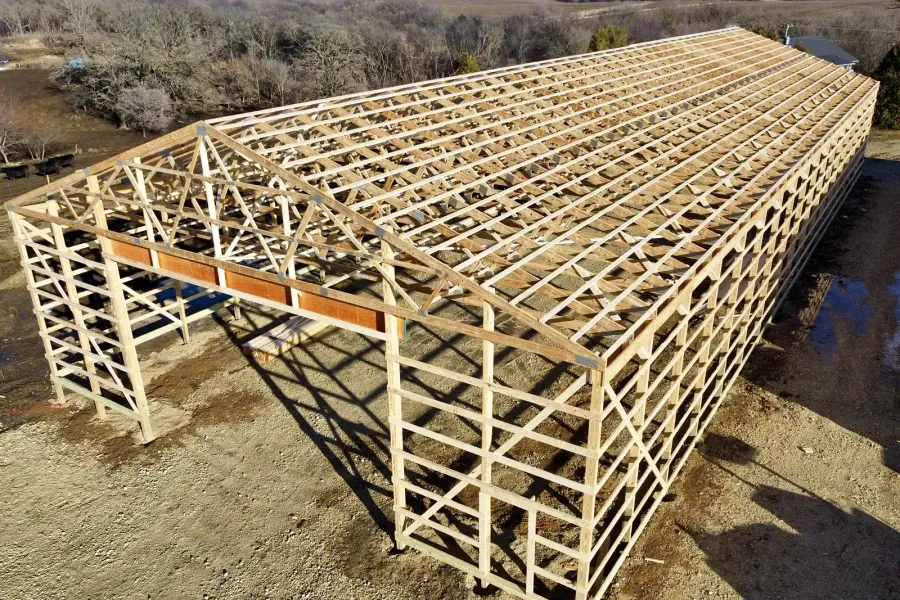
What is a post-frame home, and who is it for?
A post-frame home is framed on columns, not on walls. Solid or laminated wood columns carry the roof load down to footings. Girts span between the columns and hold the wall skin. The trusses sit on top of the columns instead of on a stud wall. Nothing inside the exterior shell holds the building up. It is the method people mean when they say pole barn house.
Every practical difference comes from that. Interior walls are partitions, so the plan can be rearranged later without touching the roof. Rooms run wide with no center bearing wall. A shop bay or a deep covered porch sits under the same roof line as the kitchen.
It fits a landowner putting a single-story house on rural acreage who wants open rooms and working space under one roof. It fits less well if you want a full second story, a basement or a masonry exterior. It also needs a lot a loaded truck can reach and turn on, which is the access question further down.
What does post-frame work involve on a Central Texas lot?
Most of it is site work. A crew stakes the building, clears and levels a pad, drills a hole for each column, sets and plumbs the columns, ties them with girts, sets trusses, runs purlins, then closes in the roof and walls. Interior framing, plumbing, wiring and finish happen inside a dry shell.
What moves a Central Texas schedule is what the auger hits. The Edwards Plateau has shallow soils underlain by limestone, with many springs, stony hills and steep canyons, so a column hole can meet rock close to the surface. Ask any builder pricing your lot how rock is handled and who carries that cost.
Pad, driveway culvert, power drop, water and septic are priced against the lot, not the building. Ask which of them sits inside the builder's number, in writing. The cost guide for a Central Texas barndominium breaks the money out, and the guide to building a barndominium in Central Texas runs the sequence from raw land to finished house.
Source: Texas Parks and Wildlife Department, Texas Ecoregions, read 2026-09-13.
What does the ground under the pad do to a post-frame build?
In Burnet and Llano counties it is rock. The Llano Uplift is a large granite batholith and the major structural feature of central Texas, with Precambrian granites and metamorphic rocks forming the central dome, and Burnet and Llano are two of its core counties. The rock is not uniform. At Inks Lake State Park in Burnet County, on the east edge of the uplift, pink Valley Spring gneiss juts up through the limestone. Ask whether the price you were given assumes one kind of ground.
Two other Texas soil regions do the opposite, and there the problem is ground that moves. The Blackland Prairies region is named for its deep, fertile black soils. Houston Black soil cracks 0.5 to 4 inches wide from the surface down 12 inches or more when dry, the defining shrink-swell behavior, and formed in clayey residuum weathered from calcareous mudstone of Upper Cretaceous age. The Post Oak Savannah is oak woodland patches interspersed with grassland, with sands and sandy loams in the uplands, clay or clay loams in the bottomlands, and a dense clay pan almost impervious to water under all soil types at only a few feet deep.
None of that decides your foundation. It decides what you ask. Put the soil report in front of the engineer designing the foundation and ask what it means for column support and embedment. Ask whether a test hole gets dug before the price is fixed. Ask the county septic office and the licensed septic installer how a clay pan changes the drainfield, because that answer often moves the house to another corner of the lot.
In the granite counties nobody from the county will catch a framing problem. Llano County issues no building permits and runs no building department, no building code and no building inspector. A Burnet County Class A permit, for a site outside any flood hazard area, is application and payment only, with no county inspection of the structure. Any structural review there is one you arrange and pay for.
Source: Texas Water Development Board, Report 360 Chapter 9, Paleozoic Aquifers of the Llano Uplift, read 2026-09-13.
Source: Texas Water Development Board, Report 360 Chapter 9, read 2026-09-13.
Source: Texas Parks and Wildlife Department, read 2026-09-13.
Source: Texas Parks and Wildlife Department, Texas Ecoregions, read 2026-09-13.
Source: USDA NRCS, Official Series Description, Houston Black Series, read 2026-09-13.
Source: Texas Parks and Wildlife Department, read 2026-09-13.
Source: Llano County Development Services, read 2026-09-13.
Source: Burnet County On-Site Sewage Facilities and Development Services, read 2026-09-13.
What do the six counties ask of a post-frame house?
None of the six has a post-frame rule. What differs is who issues the permit, whether anyone inspects the structure, and what has to be in hand first.
Behind all six sits a state option. Subchapter F applies only to a county that has first adopted a resolution or order opting in, and that is either within 50 miles of an international border or above the stated population threshold. In a covered county, new residential construction in the unincorporated area must meet the International Residential Code as published May 1, 2008, or the IRC version in force in that county seat. It creates no zoning power and does not let a county require permission before construction starts. At least three inspections are required: foundation before concrete, framing and mechanical before drywall, and on completion. The builder, not the county, contracts them, and the inspector must be one of six listed qualified persons.
That list is written around a slab. On a post-frame house the foundation is a set of columns and footings, so ask the county and the inspector you hire how the foundation inspection applies, and at what point in the column work the inspector has to be standing on the lot. Get it in writing before the auger arrives.
Inside a city limit the rules change again: a building department reviews the plans, an adopted code governs the structure, and the editions differ by town. Marble Falls is on the 2024 International Residential Code, Georgetown and Burnet on the 2021, Bastrop and Lockhart on the 2018. An extraterritorial jurisdiction is narrower. In the Leander ETJ the only permits required are for signs and water or wastewater connections, and Marble Falls issues no building permits in its one mile ETJ. Georgetown is the exception: its building permits do apply in its ETJ when the City is the water, wastewater or electric provider. Austin's extraterritorial jurisdiction reaches into four counties, Travis, Williamson, Hays and Bastrop.
Travis County is the strictest: any development requires a permit, and development includes structures, driveways, work in the county right of way, on-site sewage facilities, dividing land, and clearing, grading, filling or excavating a site. The application states the International Residential Code year the build will follow, and where a professional builder does the work, three third-party inspections are required, at foundation, framing and mechanical, and completion.
Williamson County issues no building permits and no certificates of occupancy and has adopted no residential building code. It requires a Certificate of Compliance from the County Engineer's office, the floodplain check, before a new home goes up and before a septic application is processed.
Burnet County issues building permits outside city limits and will not issue the septic permit without one. The order is fixed and an incomplete packet is not processed: 911 address, then building permit, then septic permit.
Llano County needs a county development permit, which is also how the property gets its 911 address, a septic permit, and a floodplain development permit where any of the lot is in a mapped special flood hazard area. Reviews outside the floodplain take seven to 10 business days.
Bastrop County requires one development permit for all development, with the class set by the parcel's relationship to the mapped 100-year floodplain. It inspects nothing itself, but its Commissioners Court adopted residential building code standards by resolution on September 14, 2009, and the builder contracts three inspections, at foundation, framing and mechanical, and completion.
Caldwell County requires a Residential Construction Permit and does not inspect framing or electrical work. It reviews the plat or survey, the deed, tax certificates showing current taxes paid, a sketch of the structure, the 911 address and the approved septic permit, and the parcel must be an original tract, a legally platted lot, or a tract exempt from platting.
Source: Texas Local Government Code Sec. 233.152, read 2026-09-13.
Source: Texas Local Government Code Sec. 233.153(a), read 2026-09-13.
Source: Texas Local Government Code Sec. 233.153(d), read 2026-09-13.
Source: Texas Local Government Code Sec. 233.154(a)(1), read 2026-09-13.
Source: Texas Local Government Code Sec. 233.154(a)(3), read 2026-09-13.
Source: City of Georgetown Development Services, Adopted Building Code, read 2026-09-13.
Source: City of Burnet, Burnet Code Adoption 2021 (PDF, city-hosted), read 2026-09-13.
Source: City of Marble Falls Building Division, read 2026-09-13.
Source: City of Bastrop Development Services, read 2026-09-13.
Source: City of Lockhart Council Packet, Ordinance 2021-39 (PDF, city-hosted), read 2026-09-13.
Source: City of Leander, Permits and Building Inspection, read 2026-09-13.
Source: City of Marble Falls FAQ, Do I need a permit outside the city limit?, read 2026-09-13.
Source: City of Georgetown Development Services, When do I need a Permit?, read 2026-09-13.
Source: City of Austin Planning, Jurisdictional Matters, read 2026-09-13.
Source: Travis County Transportation and Natural Resources, Development Services, read 2026-09-13.
Source: Williamson County frequently asked questions, County Engineer, read 2026-09-13.
Source: Burnet County On-Site Sewage Facilities and Development Services, read 2026-09-13.
Source: Llano County Development Services, read 2026-09-13.
Source: Bastrop County Development Services, read 2026-09-13.
Source: Caldwell County Development Ordinance, revised February 14, 2023, read 2026-09-13.
Where does the septic permit decide the floor plan?
More often than the county building rule does. An OSSF permit is required to construct, install, alter, extend or repair a septic system. A local authorized agent may adopt standards stricter than state law or TCEQ rules, and those stricter local standards control if they give greater public health and safety protection. The state does publish an exemption at 30 TAC 285.3 for a single family dwelling on a tract of ten acres or larger, but only where the system meets all Subchapter D construction standards, keeps all parts at least 100 feet from the property line, disposes of effluent on the property, and is the only dwelling on the tract.
In these counties that exemption mostly does not survive the local program. Travis County states no lot-size exemption at all: every system in its jurisdiction is covered whatever the size of the lot, with a one acre minimum for a home on septic. Bastrop County permits every installation or modification regardless of acreage, minimum half an acre with a public water supply and one acre without. Caldwell County requires an application, permit and inspection whatever the size of the tract, one acre minimum, and only a licensed installer may build the system. Burnet County and Llano County permit every on-site system whatever the size of the tract.
Near the lakes a second agency sits over the county. TCEQ designated LCRA as an authorized agent to administer its on-site sewage facility rules within LCRA's jurisdiction. LCRA regulates on-site sewage facilities within a 2,200-foot zone around the upper Highland Lakes and within a 2,000-foot zone around Lake Travis. The five lakes named in the rules are Buchanan, Inks, Lyndon B. Johnson, Marble Falls and Travis, and inside that jurisdiction a permit is required no matter the lot size.
Time it. Allow up to 30 days from the date of submission for a new system permit, not counting design or site complications, and the permitting authority must approve or deny the planning materials and the application within 30 days of receipt, with a written explanation on denial and an appeal to its supervisory body. One point is unresolved: LCRA's own pages say the Lake Travis OSSF zone is 2,000 feet, Travis County is reported to say 1,000 feet, and nothing on LCRA's site checked for this page says 1,000 feet. Ask both offices which figure applies to your address, because the drainfield is what fixes where the house sits.
Source: TCEQ, Getting a Permit for an On-Site Sewage Facility, read 2026-09-13.
Source: Texas Health and Safety Code Sec. 366.032(b), read 2026-09-13.
Source: TCEQ adopted rule text, 30 TAC Chapter 285, Rule Project No. 2021-030-285-CE, section 285.3, read 2026-09-13.
Source: LCRA On-Site Sewage Facilities Program, read 2026-09-13.
Source: LCRA On-Site Sewage Facilities Rules, Section 6, Area of Jurisdiction, read 2026-09-13.
Source: LCRA On-Site Sewage Facilities Rules, Section 10.05(b), read 2026-09-13.
Source: LCRA On-site Sewage Rules Frequently Asked Questions, read 2026-09-13.
Source: Travis County Transportation and Natural Resources, Development Services, read 2026-09-13.
Source: Bastrop County Development Services, read 2026-09-13.
Source: Caldwell County Development Ordinance, revised February 14, 2023, read 2026-09-13.
Source: Burnet County On-Site Sewage Facilities and Development Services, read 2026-09-13.
Source: Llano County Development Services, read 2026-09-13.
Does the Edwards Aquifer reach your lot?
If the land is in Travis or Williamson County, possibly, and it decides when you can start. The Edwards Aquifer Protection Program covers eight Texas counties: Kinney, Uvalde, Medina, Bexar, Comal, Hays, Travis and Williamson. In the Austin region it covers Williamson, Travis and Hays counties, handled by the TCEQ Austin Regional Office at (512) 339-2929.
The recharge zone is where the Edwards Aquifer rock units crop out, plus nearby outcrops with caves, sinkholes, faults or fractures that could let surface water in. The contributing zone is the watershed upgradient of it. Which one your parcel sits in sets the plan you need.
The plan follows the zone. On the recharge zone a Water Pollution Abatement Plan is required for any regulated activity, with no acreage floor, and approval must issue before construction starts. On the contributing zone a Contributing Zone Plan of best management practices is triggered at five acres of disturbance, or as part of a larger plan of development or sale, and below that no plan is needed. A site sitting partly on each is treated as recharge zone. Administrative review takes up to 30 days and technical review of a complete application takes 90 days.
A single-family residence may not need its own plan if it is in a master community with an approved plan, sits on a lot larger than five acres with only that one residence, or keeps impervious cover to 20 percent or less of the legal property. That last test is a design decision on a post-frame house: a wide single-story footprint and a long drive are what push impervious cover up. Check the parcel against the TCEQ Edwards Aquifer Map Viewer before the plan is drawn.
Source: TCEQ GIS metadata, Edwards Aquifer Recharge Zone - Chapter 213 Rules (TSMS), quoting 30 TAC 213.3(8), read 2026-09-13.
Source: TCEQ Edwards Aquifer Protection Program home page, read 2026-09-13.
Source: TCEQ GIS metadata, quoting 30 TAC 213.3(25), read 2026-09-13.
Source: TCEQ GIS metadata, quoting 30 TAC 213.22(2), read 2026-09-13.
Source: TCEQ, Water Pollution Abatement Plan page, read 2026-09-13.
Source: TCEQ, What Plans You Might Need, recharge zone branch, read 2026-09-13.
Source: TCEQ, Contributing Zone Plan page, read 2026-09-13.
Source: TCEQ, Edwards Aquifer Protection Program: What Plans You Might Need, read 2026-09-13.
Source: TCEQ, What Plans You Might Need, contributing zone branch, read 2026-09-13.
Source: TCEQ, Edwards Aquifer Private Residences page, read 2026-09-13.
Source: TCEQ, Edwards Aquifer Map Viewer page, read 2026-09-13.
What does a floodplain lot ask of a post-frame house?
Height, certified before you frame. A permit is required before construction or development begins inside any Special Flood Hazard Area. The floodplain administrator is responsible for making sure development complies with floodplain management regulations and other applicable codes, and that permits are applied for. The FEMA Flood Map Service Center is the official public source for flood hazard information, searchable by address.
The Elevation Certificate carries the proof. It is an NFIP administrative tool used to set the flood insurance premium rate and to document elevation for compliance with community floodplain management regulations. Land surveyors, architects and engineers authorized by law certify the elevation information on it.
Each county sets its own height. Burnet County requires one foot of freeboard above base flood elevation and recommends two in an A zone. Williamson County requires a structure at least a foot above base flood elevation, with a FEMA elevation certificate filed twice, after the slab and at completion. Bastrop County requires two feet of freeboard, extended to some Zone X areas where base level engineering has set flood depths. Caldwell County requires a home inside or within 300 feet of a floodplain to have its first finished floor at least two feet above the adjoining base flood elevation. Travis County requires lowest floor elevations and a flood venting plan, an elevation certificate before framing starts, and a finished-construction certificate within 30 days.
Two of those rules are written around a slab a post-frame house may not have. Ask the county floodplain administrator, and ask your surveyor, at what stage of column and floor work the first certificate gets shot, and how the flood venting plan works between columns. Settle it before the design is fixed.
Source: FEMA glossary, Permit for Floodplain Development, read 2026-09-13.
Source: FEMA, NFIP Floodplain Management Requirements study guide, Unit 7, read 2026-09-13.
Source: FEMA Flood Map Service Center, read 2026-09-13.
Source: FEMA 467-1, Floodplain Management Bulletin: Elevation Certificate, read 2026-09-13.
Source: FEMA, Elevation Certificate FAQ, October 2023, read 2026-09-13.
Source: Burnet County On-Site Sewage Facilities and Development Services, read 2026-09-13.
Source: Williamson County frequently asked questions, County Engineer, read 2026-09-13.
Source: Bastrop County Development Services, read 2026-09-13.
Source: Caldwell County Development Ordinance, revised February 14, 2023, read 2026-09-13.
Source: Travis County Transportation and Natural Resources, Development Services, read 2026-09-13.
What do wildfire and the Lost Pines ask of a Bastrop County build?
Clearance, and where you put the building. The 2011 Bastrop County Complex wildfire covered 32,400 acres, destroyed 1,660 homes and 36 commercial buildings, and burned for 37 days. Texas A&M Forest Service defines three home ignition zones by distance: Immediate 0 to 5 feet, Intermediate 5 to 30 feet, and Extended 30 to 100 feet, out to 200 feet if available. In the intermediate zone tree crowns should be at least 18 feet apart and the mature canopy no closer than 10 feet to the home. In the extended zone spacing is at least 12 feet at 30 to 60 feet out and at least 6 feet at 60 to 100 feet out.
Those distances are a siting decision, not a landscaping one. Where the columns go fixes the immediate zone for the life of the house, so draw the zones on the survey before you pick the building spot.
The trees carry a second rule. The Lost Pines is over 75,000 acres of loblolly pines across parts of five counties and the westernmost stand of loblolly pine in the United States. Its seasonally moist sandy soils provide critical habitat for the endangered Houston toad, federally listed on October 13, 1970, and critical habitat was designated in portions of Bastrop and Burleson counties on January 31, 1978. Bastrop County requires a Lost Pines Habitat Conservation Plan decision where the tract is in the covered area, so ask Bastrop County Development Services whether your parcel is covered before you clear anything.
Source: Texas A&M Forest Service, read 2026-09-13.
Source: Texas A&M Forest Service, read 2026-09-13.
Source: Texas Parks and Wildlife Department, Bastrop State Park, read 2026-09-13.
Source: U.S. Fish and Wildlife Service, read 2026-09-13.
Source: Bastrop County Development Services, read 2026-09-13.
What order does the work happen in?
Address, access, then permits, then dirt. In Burnet County the 911 address comes before every other permit, and driveway approval must be in hand before the address is assigned. In Caldwell County the septic permit requires the 911 address, and the Residential Construction Permit requires the approved septic permit. In Williamson County the Certificate of Compliance has to be processed before the septic application. Llano County's development permit is also the 911 address application. Bastrop County takes the development permit, the septic permit, the driveway and the address on one application.
Access is the piece people forget, and it is decided by a person, not a portal. In Llano County nothing may be installed on a county right of way, driveways and culverts included, without the precinct commissioner's written permission plus a road cut permit. In Burnet County the precinct commissioner sets culvert location, length and diameter at a site meeting. Williamson County Road and Bridge Division sizes the culvert. Travis County issues no permit at all for a driveway onto an unmaintained or unaccepted road, and where it does permit one the approach is concrete and uses corrugated metal culvert pipe at least 18 inches across. TxDOT approves a driveway onto a Farm to Market, Ranch Road or State Highway.
Columns and trusses arrive before anything is standing, so ask the builder what the approach has to carry and how wide the turn needs to be, then put the same question to the precinct commissioner who signs the culvert off.
Source: Burnet County On-Site Sewage Facilities and Development Services, read 2026-09-13.
Source: Williamson County frequently asked questions, County Engineer, read 2026-09-13.
Source: Caldwell County Development Ordinance, revised February 14, 2023, read 2026-09-13.
Source: Travis County Transportation and Natural Resources, Development Services, read 2026-09-13.
Source: Llano County Development Services, read 2026-09-13.
Source: Bastrop County Development Services, read 2026-09-13.
Post-frame, metal building or stick-built: which comparison matters?
Not the one most people argue about. Post-frame and a steel-framed metal building can wear the same steel skin and read the same from the road, but the structure underneath is different: wood columns and girts in one, a steel frame in the other. If you are weighing that choice, read metal building homes beside this page. Stud framing on a slab is the third option, and it puts the load back into the walls, which closes the floor plan up again.
The comparison that moves your budget is how much of the finish work sits inside the contract. A dried-in shell and a finished house are two different purchases, and the answer changes which trades you hire yourself. That decision is laid out in shells versus turnkey.
Financing is the comparison that catches people late. Texas Farm Credit states that it finances barndominiums, along with traditional and manufactured homes, and offers Construction and Homesite Loans covering homes under construction and the homesite itself. Capital Farm Credit states it finances barndominiums and metal homes under its construction lending, and offers Homesite Loans for buying the lot with building deferred. Fannie Mae's Selling Guide recognizes single-closing construction-to-permanent financing, where the construction loan and the permanent mortgage close together and the construction loan converts automatically when building is finished.
Then comes the appraisal. An appraiser selects comparable sales that match the subject property's physical and legal characteristics. Where few truly comparable sales exist, because the improvements are unusual or the neighborhood has few sales, the appraiser may use properties that are not truly comparable, provided the analysis is documented and explained, and may not manufacture a comparable sale by adding a vacant land sale to the contract price of a home. Ask your lender early which appraisal approach they expect on a column-framed house in your county.
Source: Texas Farm Credit, read 2026-09-13.
Source: Texas Farm Credit, read 2026-09-13.
Source: Capital Farm Credit, read 2026-09-13.
Source: Capital Farm Credit, read 2026-09-13.
Source: Fannie Mae Selling Guide, read 2026-09-13.
Source: Fannie Mae Selling Guide, read 2026-09-13.
What should you ask an independent post-frame builder in Texas?
Start from the fact that nobody checked them for you. Texas does not require a state license to work as a general contractor, though local city or county requirements may still apply, and the Texas Residential Construction Commission was abolished with its enabling Act expiring on September 1, 2009. There is no state builder registry, which is why the questions below do the work a license would otherwise do.
The trades are the part you can verify yourself. Plumbers are licensed by the state through the Texas State Board of Plumbing Examiners, which runs a public license lookup. Electricians are licensed through TDLR, non-exempt electrical work must go through a licensed electrical contractor, and TDLR runs a license search. Anyone working as an OSSF installer, apprentice, maintenance provider or maintenance technician must be licensed or registered by TCEQ, with Installer I covering standard systems and Installer II covering all system types, and TCEQ publishes a public lookup. Ask for the license numbers of the plumber, the electrician and the septic installer, and check all three yourself.
Which of these is inside your number: pad, rock, driveway and culvert, power drop, water, septic? Name each one in or out, in writing.
Who contracts the third-party inspections in this county, which qualified person will you use, and at what stage of the column work do they come out?
How are the columns supported on this soil, who stamps that decision, and does the price include a test hole before it is fixed?
What happens to the price and the schedule when the auger hits rock, and who carries that cost?
Who pulls the county permit, and whose name is on the application?
What is the written change order process, and does it start before the first hole is dug?
Can I see a house you framed on columns in this county, and can I call the owner?
Source: Office of the Texas Governor, Business Permit Office, Texas Business Licenses and Permits Guide, read 2026-09-13.
Source: Texas Sunset Advisory Commission, read 2026-09-13.
Source: Texas State Board of Plumbing Examiners, read 2026-09-13.
Source: Texas State Board of Plumbing Examiners, read 2026-09-13.
Source: Texas Department of Licensing and Regulation, Electricians program, read 2026-09-13.
Source: Texas Department of Licensing and Regulation, read 2026-09-13.
Source: TCEQ, Occupational Licenses: On-Site Sewage Facilities (Septic Systems), read 2026-09-13.
Source: TCEQ, On-site Sewage Facilities: Information for Regulators, read 2026-09-13.
How do you check your own lot before you call anyone?
From an address, most of it settles before anyone drives out. Pull the flood map at the FEMA Flood Map Service Center. Check the parcel against the TCEQ Edwards Aquifer Map Viewer if it is in Travis or Williamson County. Run the county search in TCEQ's authorized agent lookup to see which office permits your septic, because the answer is not always the county: Travis County has seven authorized agents, Burnet County has eight, Llano County has three, Bastrop County has two and Caldwell County has five, while Williamson County has a single agent covering the whole county. LCRA appears in Travis, Burnet and Llano, not in Williamson, Bastrop or Caldwell, and publishes an address-searchable jurisdiction map.
Then call the office where your land sits, by name: Travis County TNR Development Services, the Williamson County Engineer's Office, Burnet County Development Services, Llano County Development Services, Bastrop County Development Services, or Caldwell County Development Services. Ask for the permit order in writing and start there. The locations index opens the county and town pages that cover your ground.
Source: FEMA Flood Map Service Center, read 2026-09-13.
Source: TCEQ, Edwards Aquifer Map Viewer page, read 2026-09-13.
Source: TCEQ On-Site Activity Reporting System, search by county, read 2026-09-13.
Source: LCRA Water Quality Jurisdictions map, read 2026-09-13.
Source: TCEQ OARS county search, Travis County (CNTY_CD 227), read 2026-09-13.
Source: TCEQ OARS county search, Williamson County (CNTY_CD 246), read 2026-09-13.
Source: TCEQ OARS county search, Burnet County (CNTY_CD 27), read 2026-09-13.
Source: TCEQ OARS county search, Llano County (CNTY_CD 150), read 2026-09-13.
Source: TCEQ OARS county search, Bastrop County (CNTY_CD 11), read 2026-09-13.
Source: TCEQ OARS county search, Caldwell County (CNTY_CD 28), read 2026-09-13.
Source: TCEQ OARS county search, identical entry returned for Travis, Burnet and Llano counties, read 2026-09-13.
Also on this site: barndominium construction.
Questions people ask
- Do I need a building permit for a post-frame home in these counties?
- It depends on the county. Travis County requires a permit for any development. Burnet County issues building permits outside city limits and will not issue the septic permit without one. Bastrop County requires a development permit for all development in the unincorporated county. Caldwell County requires a Residential Construction Permit. Williamson County and Llano County issue no county building permits at all, though Williamson requires a Certificate of Compliance from the County Engineer before construction and before the septic application, and Llano requires a county development permit.
- Is a post-frame builder licensed in Texas?
- No. Texas does not require a state license to work as a general contractor, although local city or county requirements may still apply, and the Texas Residential Construction Commission was abolished with its enabling Act expiring on September 1, 2009. Any builder you hire is an independent business. The trades are different: plumbers are licensed through the Texas State Board of Plumbing Examiners, electricians through TDLR, and OSSF installers through TCEQ, and each agency runs a public license lookup.
- Does a post-frame house still need a septic permit on a large tract?
- In these counties, yes. The state publishes an exemption at 30 TAC 285.3 for a single family dwelling on a tract of ten acres or larger that meets a list of conditions, including keeping all parts of the system at least 100 feet from the property line. But Travis, Bastrop, Caldwell, Burnet and Llano counties each permit systems whatever the size of the tract, and inside LCRA's jurisdiction a permit is required no matter the lot size.
- Can I act as my own contractor on a post-frame home?
- The state gives an owner-builder one break: an owner-builder building their own primary residence, or acting as their own contractor on it, is not penalized for failing to give the notices. That is a notice exemption, not a permit exemption. The county permits, the septic permit, the floodplain rules and, where they apply, the required inspections all still stand. In Travis County the three third-party inspections are tied to a professional builder doing the work, so ask the county how your situation is treated before you start.
- What does a post-frame home cost in Central Texas?
- No figure belongs on this page, because the building and the lot are priced separately and the lot is where the surprises live. Pad, rock, driveway and culvert, power drop, water and septic are site items, not building items. The cost guide for a Central Texas barndominium, linked above, breaks the money down. When you compare bids, the useful question is which site items sit inside each builder's number.
Four fields, no email
Get a free estimate on post-frame homes
Your county and what you want to build. Free. No obligation. No fee to you at any point.
Tell us where the land is and what you want to build: the pad, the septic, the shell, the finish. Your request goes to one independent builder, and taking the project is their call.